History, Hominids, and the Fenland Corridor
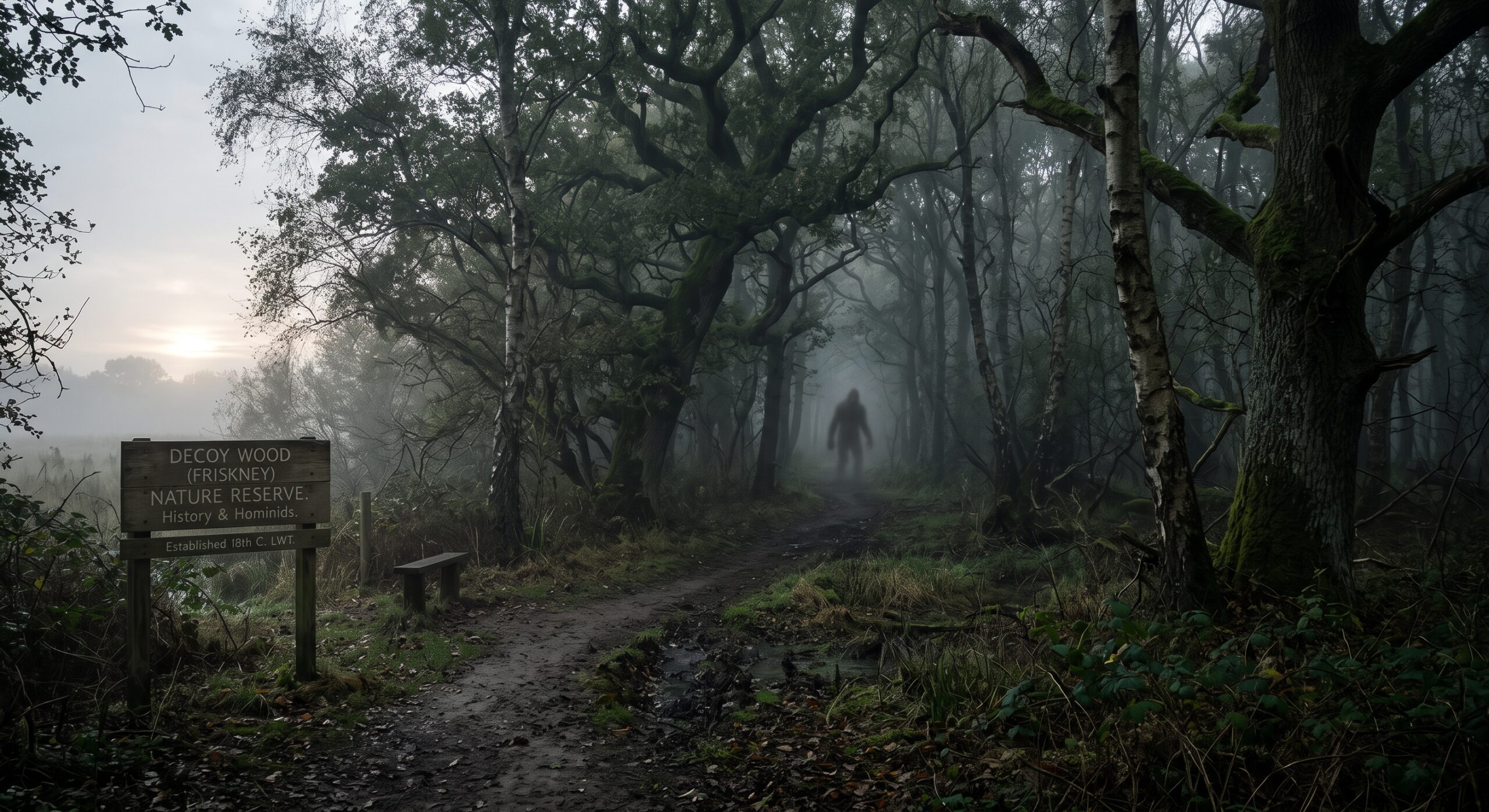
Tucked away between Boston and Skegness in the low-lying countryside of Lincolnshire lies Friskney Decoy Wood, a modest nature reserve managed by the Lincolnshire Wildlife Trust. To the casual passerby, the site appears as an unassuming 15-acre patch of damp woodland surrounded by vast, flat agricultural fields. Yet behind its peaceful treeline lies a fascinating mix of 18th-century unusual history, compelling wildman reports, and a deeper connection to regional cryptid theories.
A Legacy of Duck Decoys and Fenland History
Before the extensive drainage of the Lincolnshire Fens in the 19th century transformed the landscape into arable farmland, Friskney was famous across England for its wildfowl trapping operations. Decoy Wood takes its name from the historic duck decoy pond hidden within its centre. Built in the 1700s, the system featured a central body of water equipped with curved, net-covered channels known as “pipes.” Workers trained small dogs to lure curious wild ducks into these pipes, trapping thousands of teal, mallard, and wigeon each season to feed the bustling markets of London.
The decoy fell out of active commercial use around 1878 as fenland drainage altered local water tables. Today, the reserve is protected to preserve the earthwork remains of this bygone industry alongside its semi-natural damp woodland habitat, which shelters local birdlife, woodland flora, and small mammals.
The British Bigfoot Research Investigation
While the wood’s historical value is well documented by conservationists, it has earned a secondary reputation among researchers investigating British cryptid accounts and “Woodwose” folklore. The reserve became a point of national interest in late autumn 2014 when Adam Bird, co-founder of British Bigfoot Research, led a targeted expedition into the woods following tips logged in their database regarding unusual woodland activity.
The investigation team travelled to the site specifically after receiving reports from locals describing unnatural sounds in the reserve. During their multi-hour walk through the dense brush, the team documented heavy wood-knocks, a sound frequently described in Bigfoot field research as a form of territorial signalling, alongside heavy rustling and large, anomalous foot impressions in the soft fenland mud.
The trip made headlines across the UK press in December 2014 when Bird reviewed his expedition photographs and discovered a dark, bipedal silhouette standing behind a tree trunk. The image showed an upright figure appearing to monitor the team from the shadows, providing what researchers claimed was one of the clearest photo anomalies captured during a UK field investigation.
Eyewitness Encounters: The 2017 Campfire Incident
The 2014 expedition is far from the only detailed account linked to the area. In 2017, a local craftsman from nearby Freiston shared a chilling firsthand report of a late-night incident near the reserve. While sitting by a campfire on the edge of the woods, his dog suddenly bolted and cowered in terror. Moments later, a massive, hunched figure estimated at nearly ten feet tall crashed through the heavy undergrowth.
The witness described the entity growling deeply as it moved through the trees with terrifying force, comparing the sound to “a rhino running through the trees.” In the days following the event, the witness noted finding unusually mutilated animal remains and heavy structural damage to thick branches in the immediate vicinity where the creature had emerged.
Field Research Protocols and Archive Documentation
Independent researchers and cryptid archivists, including teams tracking UK wildman reports using regional databases like Deborah Hatswell’s British Bigfoot archives, have catalogued recurring anomalies surrounding the site over the years. Investigators visiting the small patch of fenland woods have documented several consistent field phenomena:
Vocalizations & Acoustic Signals: Visitors and field investigators have logged unnatural timber knocks, deep guttural growls, and whistling calls that do not match standard British fauna such as deer, badgers, or foxes.
Structural Anomalies: Fieldworkers have repeatedly documented tree structures within the reserve, such as heavy, freshly snapped limbs wedged unnaturally into arches or X-shapes, which researchers interpret as potential territorial markers.
Physical Impressions: Multiple independent visits to the site have recorded broad, human-like foot impressions pressed deep into the damp mud of the woodland floor, often exceeding the dimensions of standard human footwear.
The Wider Context: The Coastal Corridor Hypothesis
While field groups like British Bigfoot Research directly covered the Friskney incidents, the reports strongly mirror the broader regional theories established by renowned UK researcher Paul Sinclair, author of the Truth Proof series. While Sinclair’s boots-on-the-ground work primarily concentrates further north along the East Yorkshire coastline and the North York Moors, his framework for British cryptid behaviour provides a compelling lens when viewing the Lincolnshire reports.
Sinclair has long argued that Britain’s eastern coastal zones act as corridors of “high strangeness” where anomalous animal reports, upright bipedal encounters, and strange acoustic phenomena regularly cluster. A core pillar of Sinclair’s hypothesis is the “transient corridor” concept: large, unidentified entities do not live permanently in small, isolated parcels of woodland. Instead, they navigate between regions by utilising hidden green arteries, disused railway lines, deep agricultural drainage ditches, and overgrown hedgerows. When viewed through Sinclair’s framework, Friskney Decoy Wood is not a permanent sanctuary, but rather a temporary waystation along a vast eastern corridor stretching from the Yorkshire Wolds down through the Fenland waterways.
Furthermore, the specific signatures recorded at Friskney, sudden and intense panic in domestic dogs, deliberate timber manipulations, and deep, unnatural growling from heavy bushes align precisely with the eyewitness statements Sinclair has gathered across Yorkshire.
The Sceptical Perspective and Environmental Realities
Despite the dramatic nature of these accounts, sceptics and local naturalists urge caution. Critics suggest that the famous 2014 photograph is a classic case of pareidolia, where the human brain misinterprets natural tree bark, overlapping foliage, and deep shadows as a humanoid face or body.
Furthermore, wildlife biologists highlight a geographical reality: Decoy Wood covers roughly 12 to 15 acres. A large, undetected primate population could not permanently live inside such a small, isolated nature reserve without leaving undeniable biological proof. Proponents of the sightings counter that any transient creature would likely use the region’s network of deep drainage ditches, thick hedgerows, and isolated waterways as hidden corridors to move undetected across the Lincolnshire countryside.
Whether viewed as a vital sanctuary for historical fenland earthworks, a stopping point along an eastern cryptid corridor, or a hotspot for modern Woodowse folklore, Friskney Decoy Wood remains one of the most intriguing corners of the Lincolnshire and wider UK cryptid landscape.

Leave a Reply