The House That Isn’t There
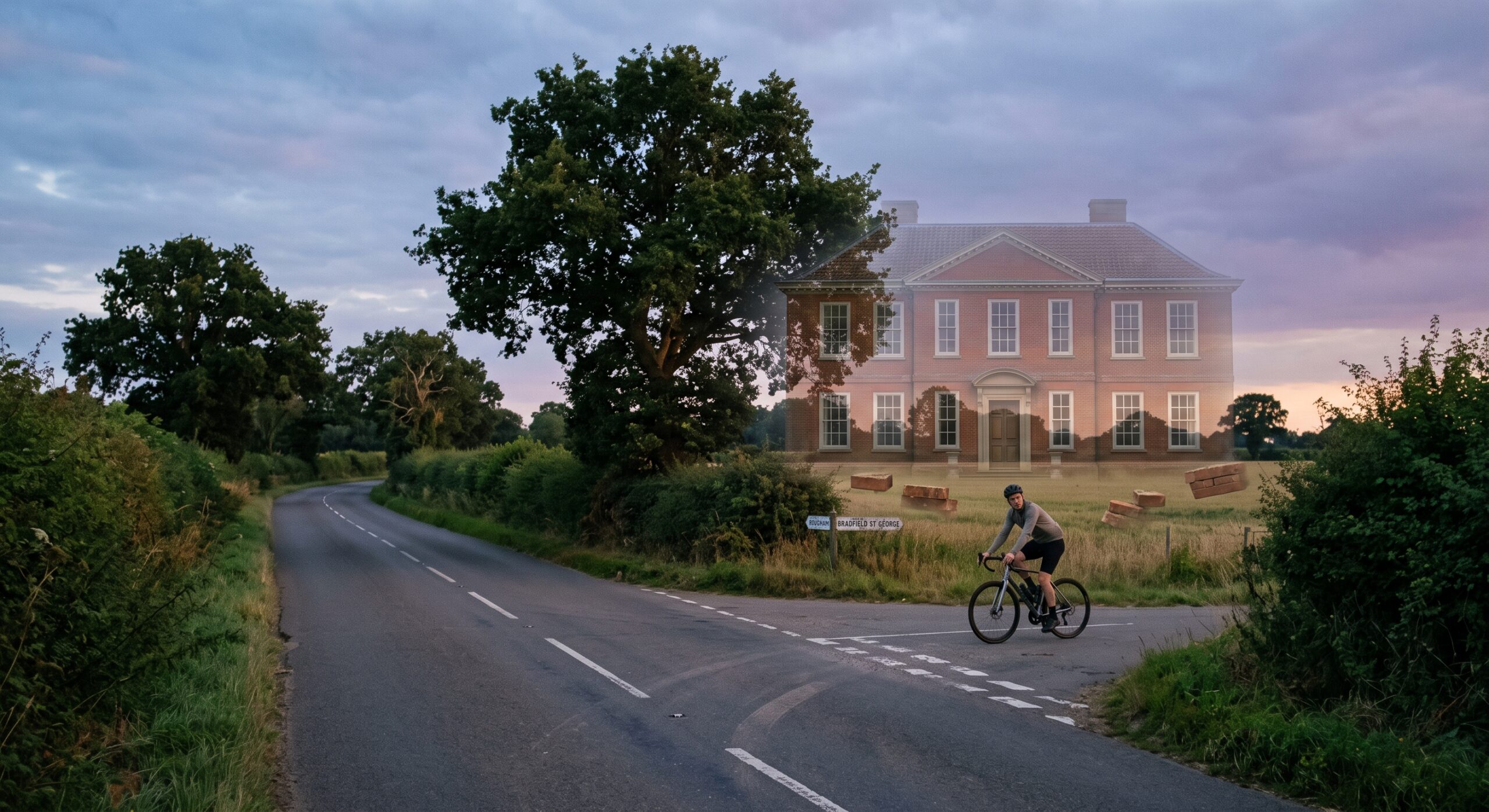
If you were driving down the quiet country lanes near Kingshall Street in Suffolk, you would expect to see rolling fields, overgrown hedges, and the occasional farmhouse. But for over 160 years, travellers along these rural roads have reported seeing something that shouldn’t exist: a magnificent, three-story red-brick Georgian mansion that appears out of nowhere, only to vanish into thin air.
Known locally as the Rougham Mirage or the Rougham Time Slip, this phenomenon isn’t a story of typical spectral figures or haunted rooms. Instead, witnesses encounter an entire “ghost building”, complete with formal gardens, tall iron gates, and blowing curtains superimposed onto an empty field.
The Signature of a Time Slip
Across more than a century of documented reports, witnesses who encounter the Rougham house almost always describe a distinct sequence of physical sensations right before the structure materializes:
An unnatural drop in temperature: A sudden, localized chill in the air, regardless of the season.
Auditory disturbances: A loud rushing or “whooshing” sound, or conversely, an eerie, dead silence where natural countryside noises disappear.
Atmospheric shift: A sudden feeling of dread, disorientation, or an unusual mist rolling across the road.
A Timeline of Encounters
June 1860: The First Recorded Sighting
The earliest documented report comes from Robert Palfrey, a local farmer walking through the fields of Rougham. Palfrey experienced a sudden temperature drop and looked up to find an imposing, red-brick Georgian mansion surrounded by vibrant, blooming gardens standing where an open meadow should have been. As he watched, the estate simply faded away.
October 1912: The Scared Pony
52 years later, Palfrey’s great-grandson, James Cobbold, was traveling in a pony trap with local butcher George Waylett. The air grew abruptly frigid, followed by a loud rushing sound that panicked the pony, throwing both men onto the lane. When Cobbold picked himself up, he saw the exact same three-story Georgian home looming over the field. Within moments, the grand house dissolved into a thick mist.
Autumn 1926: The Wall that Vanished
Schoolteacher Ruth Wynne and a 10-year-old pupil were walking near Rougham Rectory when they encountered a long, prominent brick wall made of unusual yellow and green bricks. Behind massive wrought-iron gates lay a grand driveway lined with tall trees, leading toward a large estate. Intrigued, Wynne returned to the spot months later, only to find the wall, gates, and drive gone; replaced entirely by wild, untamed hedges.
The 1940s: Catalogue Salesmen
During the Second World War, catalogue salesman Edward Bentley and two colleagues were driving down Southall Street delivering clothing catalogues. Spotting a stately home set back from the road, they backed the car up to solicit business. By the time they stopped, the entire estate had completely dematerialized.
1976–2007: Later Sightings
The anomaly continued into the late 20th and early 21st centuries:
1976: A teenager, Sandra Hardwick, cycled past a brightly sunlit cottage with open windows and blowing curtains in an empty stretch of road, overwhelmed by a sudden feeling of dread.
Late 1990s: A rector’s daughter ran, distressed, into a local pub after witnessing a structure that disappeared behind her.
October 2007: Jean and Sidney Bartram were driving along Kingshall Street when they spotted a grand Georgian home situated along the road. On their return trip shortly after, the site was once again just an open field.
Have the Encounters Stopped?
The October 2007 report by Jean and Sidney Bartram remains the last publicly logged account of the Rougham Mirage. Investigators point to a few key factors in why the encounters have reduced:
Modern Travel Speeds: Early accounts came from pedestrians, cyclists, and horse-drawn carriages traveling slowly. A driver traveling at 40 mph down a narrow lane is far less likely to notice subtle landscape anomalies or pull over in time.
Landscape Changes: Decades of agricultural work, modern housing development, and altered hedgerows may have shifted the environmental conditions or visual markers that trigger the event.
Multi-Decade Lulls: Long periods of silence are normal for Rougham. A full 52 years passed between the 1860 and 1912 sightings.
Reluctance to Report: Many people who experience anomalous events choose not to come forward for fear of public ridicule.
The Rougham Suggestions
Several theories attempt to explain the strange sightings near Kingshall Street:
The Lost Manor (King’s Hall): Old 18th-century maps show an estate called King’s Hall once existed in the parish. However, historical records state King’s Hall was a medieval or Tudor structure, leaving historians to wonder why witnesses consistently describe a Georgian-style house.
Physical Evidence: Local researchers investigating the site reported finding scattered fragments of unusual green-and-yellow brick masonry embedded in the soil, directly matching the description of the mysterious wall reported by Ruth Wynne in 1926.
Atmospheric Mirage: Skeptics suggest superior thermal inversions could project an image of an actual estate located miles away across the flat East Anglian landscape.
The “Stone Tape” / Time Slip Theory: Paranormal researchers propose that specific geological or environmental triggers in Rougham act like a recording tape, playing back a temporal “snapshot” of a bygone era to sensitive observers.
Whether the Rougham Mirage is a glitch in the fabric of time, a rare optical illusion, or an atmospheric projection of a forgotten piece of local history, it remains one of the UK’s most fascinating unsolved mysteries.
Next time you find yourself driving through the quiet backroads of Suffolk, keep an eye on the roadside, and if the air suddenly turns ice-cold, you might just catch a glimpse of the red-brick house that isn’t there.

Leave a Reply