Australia’s Unsolved Desert Enigma
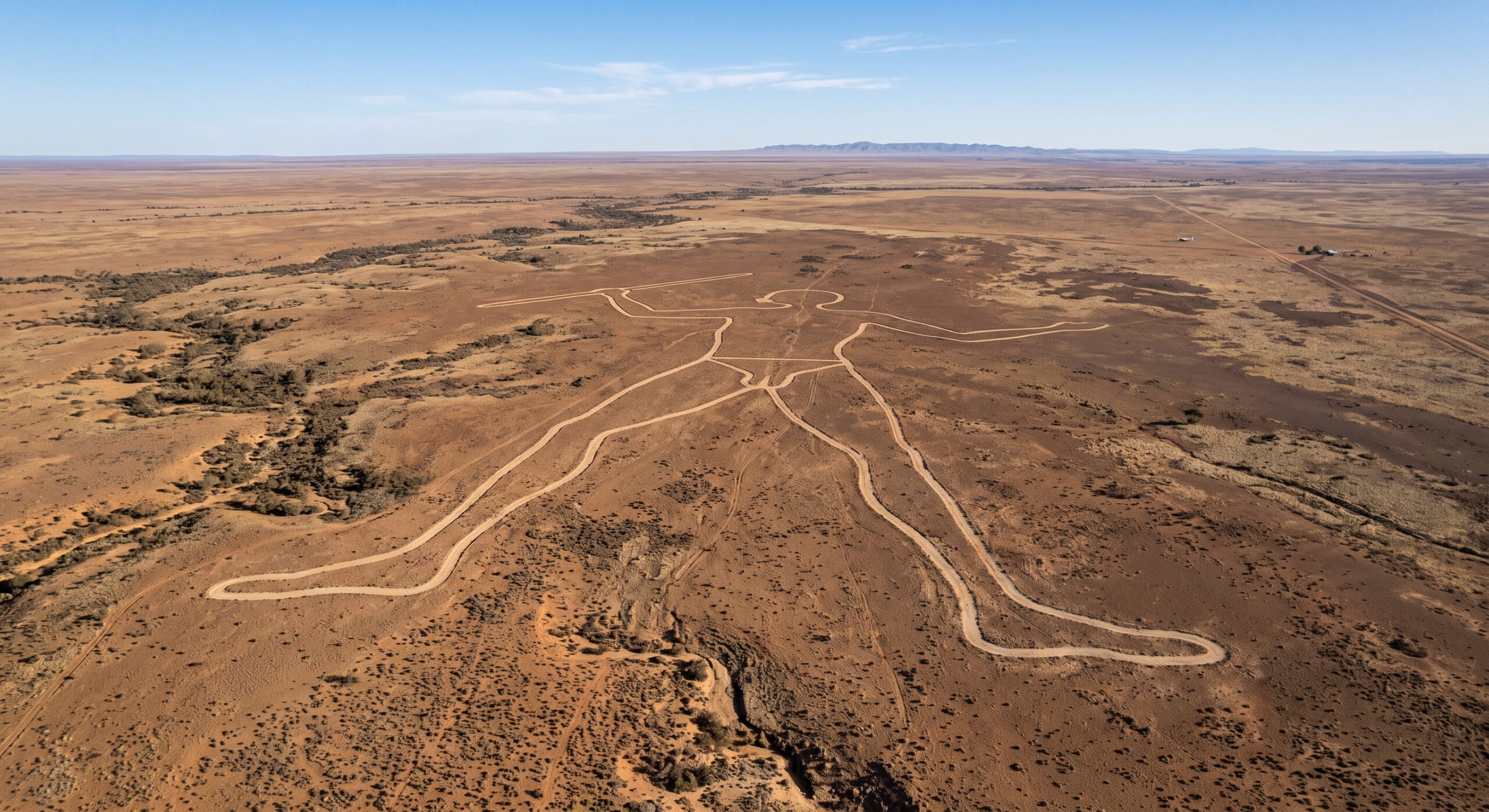
Deep in the arid outback of South Australia, roughly 60 kilometres west of the remote town of Marree, lies one of the largest and possibly second most mysterious works of land art on Earth.
Etched into a barren plateau, the Marree Man, also known as Stuart’s Giant, depicts an Indigenous Australian hunter holding a throwing stick or woomera. Measuring an astonishing 4.2 kilometres from top to bottom with a perimeter stretching over 28 kilometres, the figure is so massive that it cannot be recognized from ground level. It can only be truly comprehended from thousands of feet in the air or from low Earth orbit.
Despite being constructed in the late 1990s using modern technology, the identity of the person or group responsible remains one of Australia’s greatest unsolved mysteries.
A Chance Discovery from the Skies
The story of the Marree Man began on June 26, 1998, when Trevor Wright, a charter pilot flying between Marree and Coober Pedy, glanced down at the plateau below. Carved deep into the ironstone soil was a sprawling outline of a hunter rendered with striking proportions. Prior to Wright’s flight, there were no public records, aerial photographs, or local reports indicating that anything was being constructed in the area.
Subsequent measurements revealed the sheer scale of the operation. The lines forming the contour of the figure had been scraped approximately 35 centimetres into the hard earth, reaching widths of up to 35 metres. Whoever created the giant managed to carve through acres of rugged ground in a restricted military zone without alerting local authorities or nearby residents.
Peculiar Clues and American Fingerprints
It did not take long for investigators and journalists to realize that the creator wanted the figure to be found, leaving behind a trail of bizarre, deliberate clues:
Anonymous Press Releases: Shortly after the initial sighting, anonymous faxes were sent to local media outlets and businesses in South Australia, alerting them to the existence of the artwork. The messages were written using American spelling variants such as “labor” and “colors” and used imperial measurements like inches and feet rather than the metric system standard in Australia.
The Buried Jar: Investigators searching the site discovered a small jar buried near the figure’s head. Inside was an American flag, a note featuring the Olympic rings, and a typed excerpt from H.H. Finlayson’s 1935 book The Red Centre, describing the traditional hunting methods of the Pitjantjatjara tribe.
Military-Grade Precision: Creating a geoglyph of that scale with near-perfect proportions required sophisticated equipment. In 1998, high-precision differential GPS technology was not widely available to the public and was primarily used by military or commercial surveying teams.
The Leading Theories: Who Built It?
Over the decades, three primary theories have emerged regarding who was behind the creation of the Marree Man.
The Local Artist Confession
In 2018, Alice Springs businessman Richard Warner claimed that local artist Bardius Stubing was the mastermind behind the geoglyph. According to Warner, Stubing confessed on his deathbed in 2002 that he had used a GPS-guided tractor to carve the shape, supported by two lookouts. However, Stubing’s family strongly denied the claims, and many skeptics doubt that a lone local artist could operate heavy machinery undetected for days in a restricted zone without leaving a clearer physical footprint.
American Military or Intelligence Personnel
Because the site lies near the Woomera Prohibited Area and the joint Australia–United States defence facility at Pine Gap, many believe American military personnel were involved. The presence of the American flag, US English spelling in the press releases, and access to classified or high-precision GPS technology support the idea that it may have been an elaborate prank, a calibration exercise for satellite imaging, or a high-tech land-art experiment carried out by US personnel stationed nearby.
An Elaborate Land-Art Stunt
Another popular theory suggests an American artist, working alongside local pilots or contractors, designed the figure as an ambitious land-art installation. The inclusion of quotes from Australian anthropological literature suggests the creator was someone with a keen interest in Indigenous Australian history, combining local cultural themes with American-style publicity tactics.
Why the Mystery Endures
Initial investigations by South Australian police and the Department of Defence quickly stalled. Rains and desert winds shortly after the discovery swept away tire tracks and heavy machinery trails leading into the plateau. Furthermore, despite rewards offered by the town of Marree for concrete information, no physical logs, machinery receipts, or GPS data files have ever been produced.
As the years passed, weathering caused the light topsoil of the figure to fade. To preserve this unique piece of outback folklore, local residents and business owners from Marree used a grader in 2016, guided by original satellite coordinates to carefully restore the outline. Today, the Marree Man remains carved clearly into the Australian desert, continuing to draw flight-tourists and intrigue researchers from all over the globe.

Leave a Reply