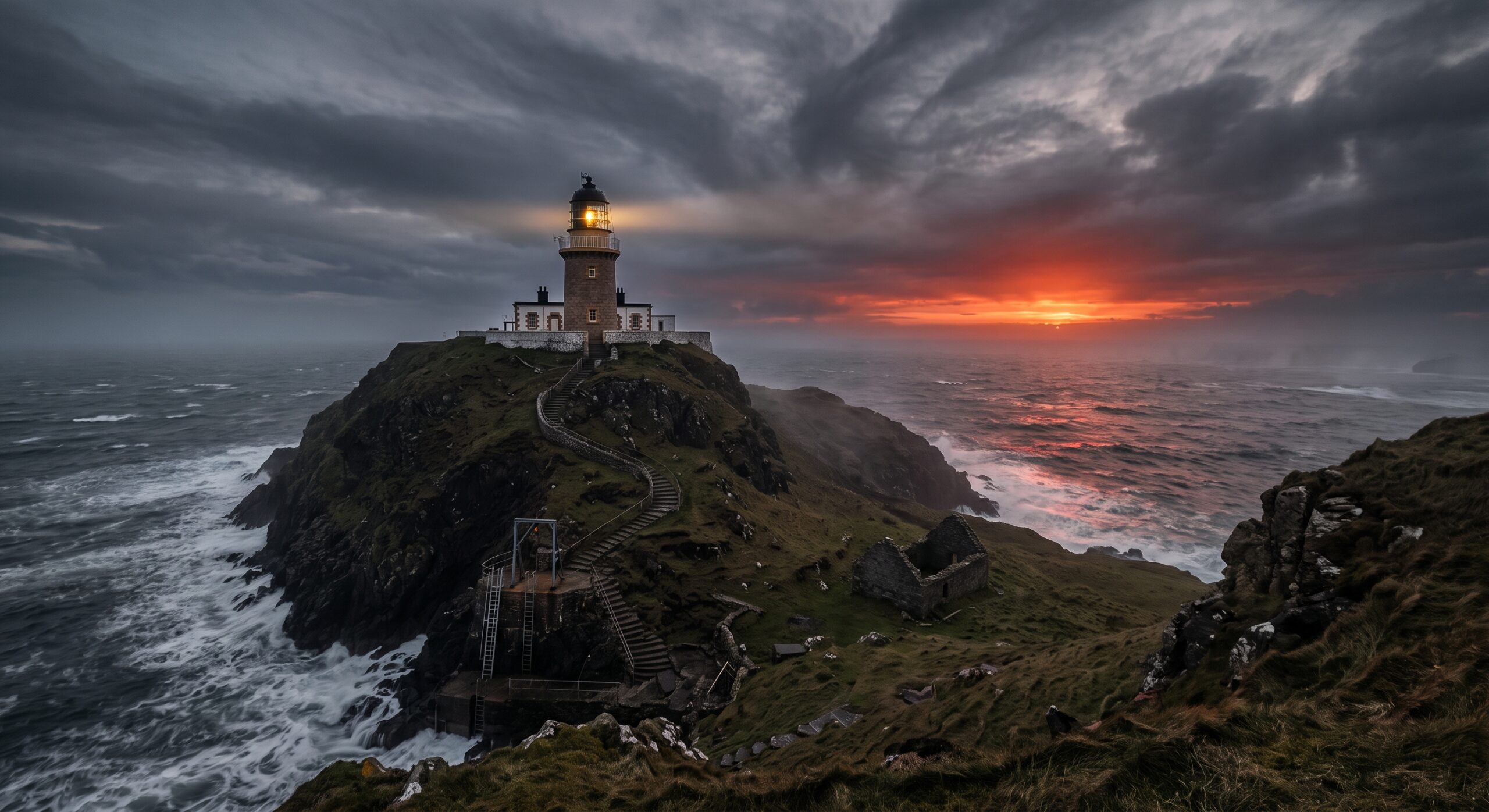
The Night The Eilean Mòr Lighthouse Went Dark
On a storm-lashed December evening in 1900, a passing steamer battling rough seas off the outer edge of Scotland noticed a chilling sight. Eilean Mòr, a jagged pinnacle of rock rising sharply out of the North Atlantic, was shrouded in complete darkness. The powerful 140,000-candlepower beacon of the Flannan Isles Lighthouse, a light built specifically to guide ships safely around the Outer Hebrides, had gone out.
What followed became one of the most famous maritime mysteries in history: three seasoned lighthouse keepers vanished without a trace from a locked, isolated island station, leaving behind an array of subtle, baffling clues. Over the past century, the tragedy of Eilean Mòr has been shrouded in folklore, ghost stories, and sensational fabrications. But when we look closely at the primary historical records, a far more grounded and tragic story emerges.
Eilean Mòr: The Island of Spirits
Eilean Mòr, translated from Gaelic as Big Isle, is the largest of the seven tiny, uninhabited Flannan Islands lying approximately 20 miles west of the Isle of Lewis. For centuries, the island was viewed with superstitious dread by local Hebridean fishermen and shepherds. They considered Eilean Mòr an unholy, otherworldly place inhabited by spirits and the “phantom inhabitants of the seas.” Shepherds who landed sheep on the island for grazing refused to stay overnight, retreating to their boats before sunset.
Despite these local warnings, the Northern Lighthouse Board (NLB) identified the treacherous rocks as a critical hazard for transatlantic shipping routes. Construction began in 1895 under the direction of famed Scottish engineer David Alan Stevenson. Workers had to haul granite blocks up sheer 150-foot cliffs using steam-powered cranes anchored into the basalt.
Completed in late 1899, the 75-foot stone tower was a triumph of Victorian engineering, built to withstand the most violent tempests the Atlantic could produce. It was designed to be permanently operated by a three-man crew, with a fourth rotating keeper stationed ashore at the Breasclete wireless station on the Isle of Lewis.
By December 1900, the station was occupied by three highly experienced and respected mariners:
James Ducat: The Principal Keeper, aged 43. A veteran officer of the Northern Lighthouse Board with over 20 years of flawless service, Ducat was a husband and father of four who was known for his calm, methodical nature.
Thomas Marshall: The Second Assistant Keeper, aged 28. Unmarried and capable, Marshall was a quiet man with years of seafaring experience along the rugged Scottish coastline.
Donald MacArthur: The Occasional Keeper, aged 40. A physical, hard-working mariner and husband who was stepping in for First Assistant Keeper William Ross (who was off on sick leave).
The Timeline of the Disappearance
The timeline of the disaster shows how quickly routine turned to tragedy over a few fateful December days.
December 15, 1900: The Phantom Light
The transatlantic steamer SS Archtor, sailing from Philadelphia to Leith under the command of Captain Holman, passed Eilean Mòr during heavy weather. At 12:00 midnight, Holman noted in his logbook that the lighthouse light was extinguished. Heavy ocean swells and thick mist made it impossible to land a boat to investigate, but upon arriving in port at Coshead, Holman notified maritime authorities. Sadly, the message failed to reach the Northern Lighthouse Board in time.
December 26, 1900: The Relief Vessel Arrives
The scheduled relief ship Hesperus, captained by James Harvie, was delayed for over a week by relentless winter gales. When the ship finally anchored off Eilean Mòr on Boxing Day, the crew immediately realised something was catastrophically wrong.
There was no flag flying from the station’s flagstaff. No empty supply boxes had been placed near the landing platforms, and none of the three keepers appeared to answer the ship’s steam whistle or distress flares.
Relief keeper Joseph Moore was put ashore alone in a small boat at the East Landing. He sprinted up the steep, zigzagging stone staircase to the lighthouse compound. Reaching the perimeter wall, he found the compound gate and the heavy outer entrance door firmly shut.
Inside the living quarters, Moore discovered an eerie, silent scene:
The inner doors were closed.
The kitchen clock had stopped ticking, its weights unwound.
The hearth was dead and filled with cold, black ash.
The beds were unmade, suggesting the men had risen normally for their day shift.
A single wooden chair sat overturned on the floor near the kitchen table.
Shaken, Moore ran back down to the landing to inform Captain Harvie. The Hesperus second mate and a seaman returned to the island with Moore to conduct a comprehensive search of the station tower and grounds.
December 29, 1900: The Formal Investigation
Superintendent Robert Muirhead, the Northern Lighthouse Board officer who had personally interviewed and hired Ducat, Marshall, and MacArthur, arrived on the island aboard the Hesperus to head an official forensic inquiry. Muirhead spent days inspecting every square foot of the living quarters, the light room, and the severe weather damage on the island’s western side.
The Forensic Evidence: Order Inside, Destruction Outside
What struck investigators most was the stark contrast between the interior of the lighthouse and the exterior slopes of Eilean Mòr.
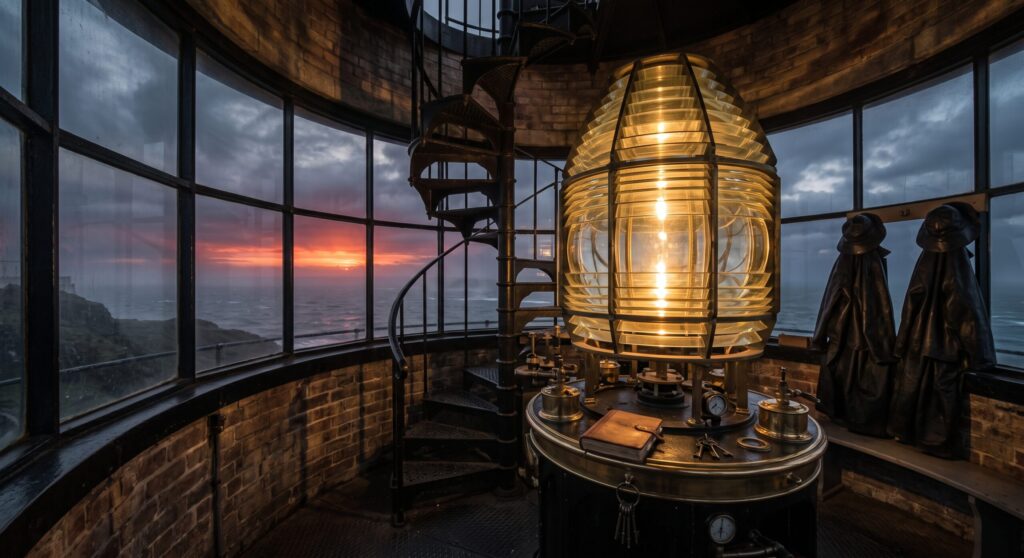
Inside the lantern room at the top of the tower, Muirhead found the light apparatus in perfect working order. The brass fittings were polished, the glass lenses were spotless, and the lamps had been carefully cleaned, refilled with oil, and trimmed, ready to be lit for the evening of December 15. The window blinds were drawn, and oil cans had been stowed neatly in their designated racks.
The crucial evidence lay in the cloakroom and down at the island’s West Landing:
Clothing Left Behind: Two sets of heavy oilskins waterproof coats and trousers were missing from the cloakroom pegs. However, Donald MacArthur’s oilskin jacket remained hanging on its hook. This proved that while two men went out properly dressed for severe weather, the third man left the tower in his shirtsleeves.
Devastation at 110 Feet: At the West Landing stage, which sat inside a narrow, funnel-shaped gulley, the storm had wrought terrifying structural damage. An iron crane used for hauling supplies, bolted to concrete 110 feet above sea level, had its iron railings bent sideways and twisted like wire.
Scattered Supplies: A heavy wooden storage box containing mooring ropes and landing gear bolted into a crevice in the basalt rock over 108 feet above the sea had been completely ripped from its mountings, smashed into splinters, and scattered across the rocks. Concrete armour blocks had been torn from the stone path, and a boulder weighing over a ton had been shoved several feet out of its socket on top of the cliff.
Debunking the Urban Myths
In the years following the tragedy, tabloid journalists, pulp writers, and folklorists sensationalised the mystery, inventing eerie details that eclipsed the factual evidence recorded by Joseph Moore and Robert Muirhead.
Myth 1: The “Psychological” Logbook Entries
The Myth: Sensational books claim the final logbook entries read like a psychological thriller. In these fake entries, Thomas Marshall allegedly wrote that veteran keeper James Ducat had gone “very quiet,” that MacArthur was “crying openly,” and that the men were praying in terror during a storm, ending with the line: “Storm ended, sea calm. God is over all.”
The Fact: These entries were completely fabricated by writer Vincent Starrett in a 1912 article for True Strange Stories. The actual bound station logbook was kept only up to December 13, after which entries were recorded on a slate. The final chalked weather entry was made at 9:00 AM on Saturday, December 15. It contained only routine measurements of barometric pressure, temperature, and wind direction. There was no mention of men crying or strange psychological distress.
Myth 2: The Half-Eaten Warm Meal
The Myth: Popular retellings state that Joseph Moore entered the kitchen and found a half-eaten meal of mutton and warm tea sitting on the table, as if the men had been snatched into thin air mid-bite.
The Fact: In his official written statement submitted to the Board on December 28, 1900, Joseph Moore wrote: “The kitchen utensils were all very clean, which is a sign that it must be after dinner some time they left.” The table was cleared, the dishes were washed, and the room was put in order before the keepers departed.
Myth 3: Breaking the Unbreakable Rule
The Myth: Critics argued that because Northern Lighthouse Board rules strictly forbade leaving a light station completely unmanned, an unknown, paranormal force must have dragged all three men away simultaneously.
The Fact: The absence of only two sets of oilskins provides a logical explanation. Marshall and Ducat likely went down to the West Landing during high tide to secure the rope box as a storm approached. When an unexpectedly violent wave threatened them, MacArthur, who was on watch inside the tower, likely looked out the window or heard a shout and rushed down to assist without taking the time to put on his heavy storm jacket.
The Official Inquiry Conclusion: The Monster Roller
On January 8, 1901, Superintendent Robert Muirhead submitted his final report to the Northern Lighthouse Board in Edinburgh.
Muirhead knew the men personally and praised their professionalism, writing:
“I am completely satisfied that the men had been on duty up till dinner time on Saturday the 15th of December… and that an extra-large sea had rushed up the face of the rock, had gone above them, and coming down with immense force, had swept them completely away.”
In the unique geography of Eilean Mòr, narrow sea inlets act as funnels for deep ocean swells. When a powerful storm surge strikes these basalt channels at high tide, water can be forced upward in a column reaching well over 100 feet above sea level. This phenomenon, known today as a rogue wave or freak surge, hit the West Landing while the men were attempting to lash down equipment. Swept off the rocky ledge into the freezing Atlantic waters, the men would have succumbed to hypothermia within minutes, their bodies carried away by the powerful offshore currents.
The Enduring Legacy of the Flannan Keepers
James Ducat left behind a wife and four children; Donald MacArthur left a wife and two children. The tragedy left a dark shadow over Eilean Mòr, making it difficult for the Northern Lighthouse Board to find replacement keepers willing to serve on the isolated rock.
The mysterious vanishing inspired decades of creative work, including Wilfrid Wilson Gibson’s famous 1912 poem Flannan Isle, an opera by Sir Peter Maxwell Davies, and the 2018 thriller film The Vanishing.
In 1971, the Flannan Isles Lighthouse was converted to automatic operation, eliminating the need for human keepers on the island. Today, the solar-powered beacon shines every 30 seconds across the dark waters of the Outer Hebrides, a silent monument to Thomas Marshall, James Ducat, and Donald MacArthur.

Leave a Reply