Radio Blackouts, Alien Encounters, and Secret Rockets
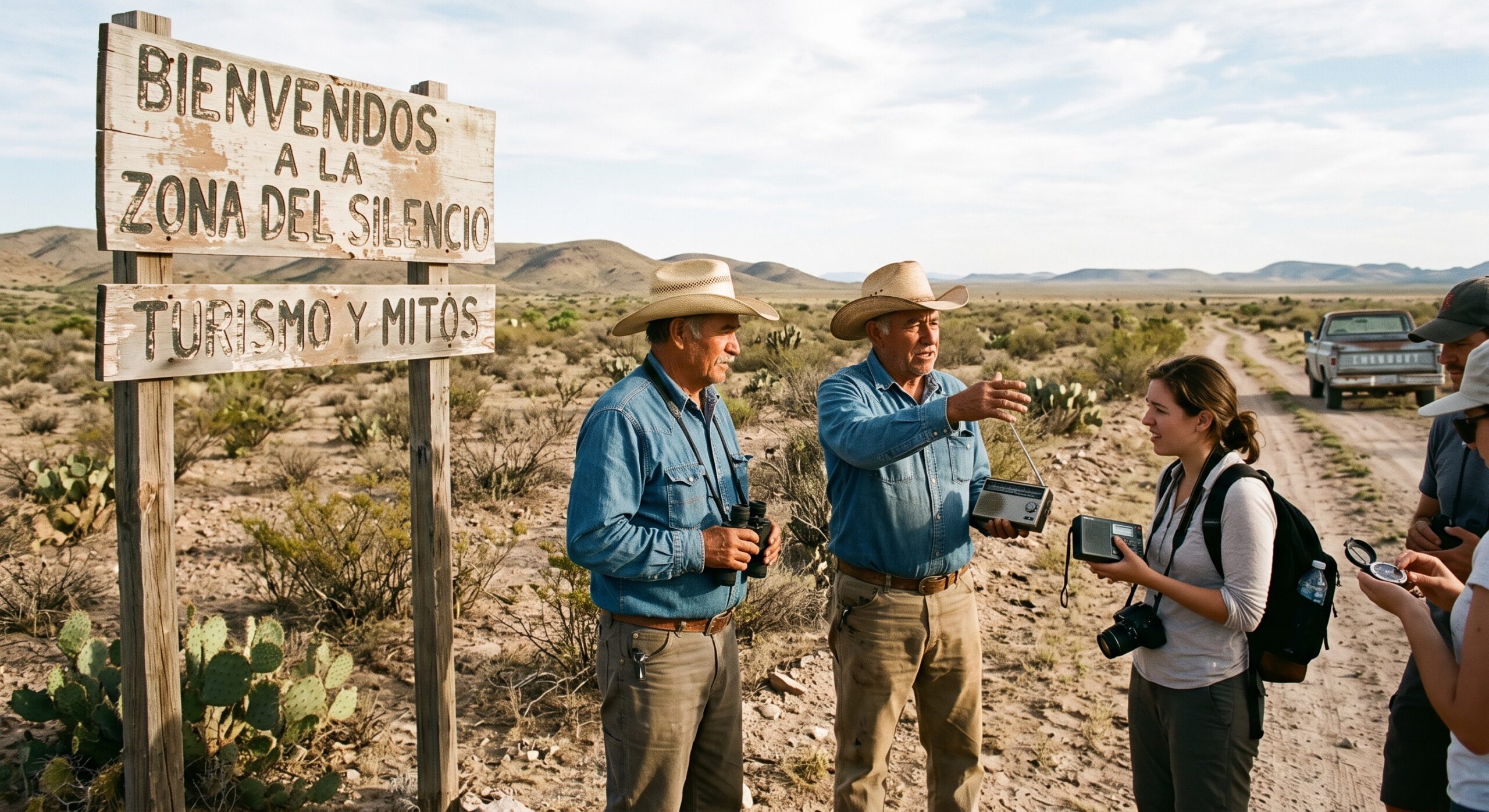
Deep within the Mapimí Desert, where the Mexican states of Durango, Chihuahua, and Coahuila converge, lies a patch of arid wilderness shrouded in modern myth: La Zona del Silencio – The Zone of Silence.
Part of the vast Chihuahuan Desert ecosystem, this isolated region has spent decades at the centre of sensational headlines, military cover-ups, and strange paranormal activity. According to desert legend, the Zone of Silence is an electromagnetic abyss, a location where radio transmissions drop dead, compass needles spin helplessly, satellite signals dissolve into static, and cosmic debris is drawn down from the sky. Over the decades, these electromagnetic claims have blended with eerie accounts of tall blonde extraterrestrials, glowing orbs, and secretive Cold War military recoveries.
To understand how a remote stretch of Mexican desert became one of the world’s most infamous anomalous zones, we must trace the combination of historical aviation reports, oil field expeditions, high-stakes military misadventures, and local experiences and storytelling.
The Anatomy of a Legend: Radio Blackouts and Unusual Encounters
The core reputation of the Zone of Silence rests on two pillars: persistent claims of localised electromagnetic anomalies and vivid firsthand accounts of bizarre encounters.
Electromagnetic and Instrument Failures
The primary phenomenon associated with the region is the sudden, inexplicable failure of radio equipment and magnetic compasses. Early accounts describe pilots and surveyors traveling through the Mapimí Desert, only to find that shortwave equipment cut out without warning. Analogue compasses were said to lock up or wander erratically near localised rock formations, most notably around Cerro San Ignacio.
While scientists stationed at the Mapimí Biosphere Reserve have demonstrated that standard radio gear functions properly throughout the area, short-range communications can suffer from terrain shadow and attenuation due to the expansive topography and distance from broadcast towers. However, these apparent natural communication dead spots evolved into the idea of a permanent, skyward-reaching “cone of silence” that isolates the desert floor from the outside world.
The “Tall Blonde” Humanoid Sightings
Among the stranger aspects of the region’s rumours are recurring eyewitness reports of humanoid entities. Throughout the 1970s and 1980s, local ranchers and travellers reported encounters with tall, fair-skinned, light-haired individuals wearing seamless clothing or raincoats, often referred to in ufological circles as “Nordic aliens.”
One widely cited report occurred in 1975, when a couple, Ernesto and Josefina Diaz, found their pickup truck trapped in a sudden desert flash flood. According to their account, two tall figures with striking features and yellow raincoats appeared beside the vehicle. Without speaking a word, the strangers effortlessly pushed the heavy truck out of the deep mud. When the couple stepped out of the vehicle to thank them, the figures had completely vanished, leaving no footprints or trace behind them.
Other local livestock owners near Ceballos told similar stories of three tall, pale strangers, two men and a woman, who occasionally approached isolated ranches. They spoke an unusual form of Spanish with a strange but melodic tone, requesting water from local wells, and politely refusing food or money when offered. When asked where they were from, the individuals would simply gesture toward the sky and reply, “From above.”
Luminous Phenomena and Meteorite Falls
In addition to radio dead spots and entity encounters, residents along the perimeter of the desert have long reported unusual aerial displays. These range from low-flying, silent spheres of white and orange lights that hover a few feet above dry riverbeds, to high-altitude lights that follow desert tracks at night.
The desert’s reputation as a magnet for space debris was heavily reinforced in February 1969 when the famous Allende Meteorite tore through the atmosphere, illuminating the night sky with a blinding flash and dropping thousands of broken fragments across the region. The incident fuelled theories that dense, subterranean iron and meteorite deposits formed an underground magnetic shield capable of drawing down celestial objects and disrupting electromagnetic signals.
Timeline of Events: The Evolution of the Zone of Silence
Late 1930s – The Sarabia Flight: Mexican aviator Francisco Sarabia experiences a sudden, total failure of his flight instruments and radio while flying over the Mapimí Desert. Sarabia manages to land his aircraft visually and later reports encountering an isolated aerial dead zone where electronic signals cut out completely.
1966 – The Pemex Oil Survey: Engineer Augusto Harry de la Peña leads an exploration crew through the region on behalf of Petróleos Mexicanos. During routine field operations, de la Peña notices that walkie-talkie transmissions across short distances are consistently choked out by heavy static. After testing the equipment outside the desert perimeter, where it functions normally, he becomes one of the first researchers to publish articles proposing a localised magnetic anomaly within the region.
February 8, 1969 – The Allende Meteorite Impact: At 1:05 AM, a massive fireball streaking across the sky explodes over northern Mexico, scattering thousands of fragments of the Allende meteorite over the desert near Parral and the Mapimí basin. The event brings international geologists and meteorite hunters to the area, cementing the desert’s reputation as a focal point for celestial activity.
July 11, 1970 – The Athena Rocket Crash: The U.S. Air Force launches a test Athena missile carrying two containers of radioactive Cobalt-57 from Green River, Utah, targeted at the White Sands Missile Range in New Mexico. A guidance malfunction causes the rocket to stray hundreds of miles off course, soaring deep into Mexican airspace and crashing into the Mapimí Desert.
July–August 1970 – The Recovery Mission and “Zoneros”: The U.S. military initiates a secretive search and recovery effort to retrieve the radioactive material. Working alongside Mexican authorities, crews locate the crater, build a temporary railway spur into the desert, and excavate tons of contaminated soil. Local residents hired as perimeter guards, later dubbed zoneros, witness heavy military security, specialised radiation detection equipment, and strict quarantine protocols.
1975 – The Diaz Flash Flood Encounter: Ernesto and Josefina Diaz report being rescued from a desert mud trap by two tall, light-haired strangers in yellow raincoats who vanish instantly after pushing their stranded vehicle to safety.
Late 1970s – Media Expansion and Ecotourism: Sensational media coverage, published articles by de la Peña, and stories shared by local guides turn the “Zone of Silence” into an international tourist curiosity. Tour operators, journalists, and paranormal investigators flock to Ceballos, seeking radio dead spots and UFO sightings.
1978 – Establishment of the Mapimí Biosphere Reserve: UNESCO and the Mexican Institute of Ecology establish the Mapimí Biosphere Reserve to protect the unique desert ecosystem, including the endangered Bolson tortoise. Stationed researchers conduct long-term field studies, demonstrating that standard radio and compass equipment functions regularly within the reserve, attributing local signal degradation to terrain features and distance rather than subterranean magnetic forces.
When the Myth Meets the Reality
As twilight settles over the vast, sun-baked expanse of the Mapimí Desert, the boundary between historical fact and the unexplained remains delightfully blurred. Whether La Zona del Silencio is truly a playground for localised electromagnetic anomalies or simply a remote wasteland elevated by Cold War secrecy, misplaced rockets, and runaway human imagination, one truth remains: the desert holds onto its secrets very tightly.
As technology advances and satellite coverage reaches every corner of the globe, the Zone of Silence stands as a rare, quiet sanctuary of mystery in a hyper-overconnected world. Perhaps the static echoing from a portable radio out in those lonely dunes is nothing more than bad reception, or perhaps, just beyond the frequency of human understanding, the desert is still trying to quietly whisper something to us.

Leave a Reply