Devon’s Impossible Footprints
On the morning of February 9, 1855, residents across East and South Devon, England, stepped out of their homes into a quiet winter landscape. A heavy snowfall had blanketed the region overnight, covering roughly 30 separate towns and hamlets, including Exmouth, Dawlish, Teignmouth, and Topsham. But as the townspeople began clearing their walkways, they noticed something deeply eerie.
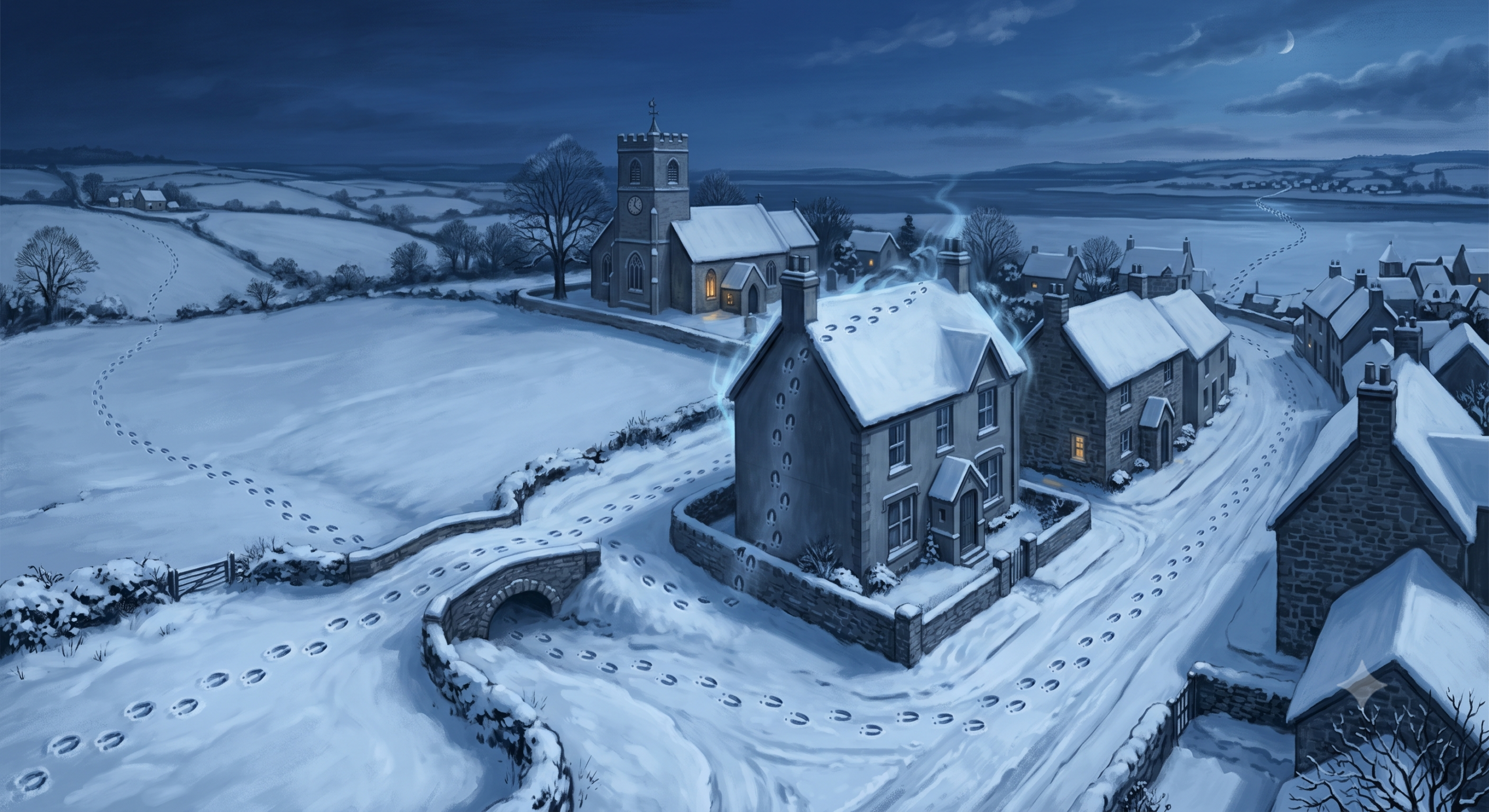
Stretching through the fresh powder was a single, continuous line of mysterious hoof-like impressions. The discovery sent shockwaves through Victorian Britain. Locals quickly dubbed the phenomenon “The Devil’s Footprints,” convinced that Satan himself had prowled through their villages while they slept. But what actually happened on that freezing winter night, and why does this mystery continue to intrigue historians over a century later?
What Made the Tracks So Bizarre?
Footprints in fresh snow are hardly extraordinary, but the characteristics of the Devon tracks defied conventional logic. First was the sheer scale of the phenomenon. Estimates of the trail’s total length ranged from 40 to over 100 miles, all laid down in a single six-hour window. For a single ground animal to cover that distance in one night seemed physically impossible.
Second was the gait. Rather than alternating left and right like a normal four-legged creature, the prints formed an unbroken, razor-straight line. It appeared as though the entity walked on two legs with uncanny precision and placed each step directly in front of the last.
Most unsettling of all was how the trail interacted with obstacles. The tracks did not wind around barriers; they went over them. Prints were discovered on top of high walls, snow-covered roofs, haystacks, and inside locked gardens. In some accounts, the trail stopped at one side of a solid wall or haystack and resumed cleanly on the other side without disturbing the surrounding snow. Two witnesses even reported tracks leading directly into a four-inch drainpipe and emerging out the opposite end.
The Primary Evidence
Much of what we know today comes from Reverend H.T. Ellacombe, the vicar of Clyst St George. An avid antiquarian and amateur scientist, Ellacombe recognised the historical significance of the event and systematically reached out to vicars, magistrates, and schoolmasters across Devon to record precise measurements and sketches. His collected correspondence revealed striking, consistent details across different villages:
Dimensions: Observers consistently measured the prints at roughly 4 inches long and 2.75 inches wide, spaced 8 to 16 inches apart.
Shape: Rather than rounded paws or split cloven hooves, the marks resembled those of a tiny donkey or an unshod horse, featuring a distinct, triangular inner structure similar to a frog.
The Exe Estuary Barrier: Perhaps the biggest physical puzzle in Ellacombe’s records was the River Exe. The trail appeared on both the eastern bank at Exmouth and the western bank at Dawlish. The river, over two miles wide in places, was not frozen that night. For one creature to make the entire journey, it would have had to cross miles of open, ice-cold water without altering its walking pace or track pattern.
Victorian Media and the “Satan” Panic
The timing of the event coincided with a period of heightened religious sentiment and intense public fascination with the supernatural.
During Sunday services following the snowfall, several local clergymen seized on the tracks from the pulpit, declaring them a literal warning from God that the Devil was wandering Devon in search of unrepentant sinners.
The panic went nationwide on February 24, 1855, when The Illustrated London News published a sensational feature on the phenomenon. Once national newspapers picked up the story, localized, independent reports were merged into a single narrative of a 100-mile Satanic walk. As word spread, copycats and local pranksters began creating their own tracks using warm brass irons, boots, or wooden stamps, further muddying the original evidence.
The Modern Consensus
For over a century, many theories were proposed. Naturalists suggested jumping wood mice, badgers, or otters searching for food. Others rumoured that kangaroos, monkeys, or swans had escaped from private menageries, while one popular theory claimed a weather balloon had broken loose from the Devonport Dockyard, dragging a heavy metal shackle across roofs and fields.
In the late 20th century, Fortean researcher Mike Dash conducted a comprehensive audit of all surviving 1855 letters and documents. He concluded that there was never a single creature or single 100-mile track. Instead, the Devil’s Footprints were the result of a natural “perfect storm”:
Multiple Independent Events: Overnight, various local animals, such as wood mice, badgers, and stray ponies, travelled across the fresh snow. Bounding animals like mice hop by placing their hind feet into the prints of their front feet, creating a single linear line of tracks.
Weather Distortion: A rapid freeze-thaw cycle overnight caused warm air and melting snow to expand small paw impressions into outer, horseshoe-like shapes. In some areas, loose ropes or debris dragged by wind added to the erratic marks on roofs.
Media Aggregation: In the morning, panicked locals and sensationalised newspaper reports linked these separate, distorted tracks across 30 miles into one continuous “demonic” trail.
Ultimately, the Devil’s Footprints remains a masterclass in how environment, animal behavior, and human imagination collide. Science may provide a logical explanation, neatly attributing the phenomenon to distorted paw prints and freezing weather, but logic does little to dim the eerie imagery of that cold winter night. Over 170 years later, the idea of a solitary, unnatural devil-type figure stepping silently across Victorian rooftops endures as one of Britain’s most haunting devil-type urban legends.


Leave a Reply