Real Life Fiend to Masked Vigilante
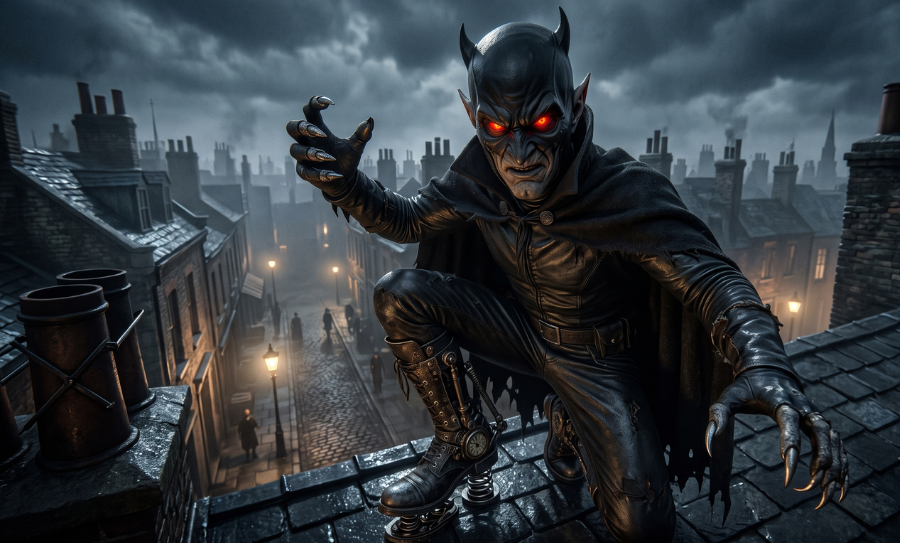
Late one winter evening in February 1838, eighteen-year-old Jane Alsop answered a frantic knocking at her family’s front door in Southwest London. A man standing in the shadows claimed to be a police officer who had just caught the neighbourhood’s notorious phantom. But when Jane brought a candle closer, the figure threw off his dark cloak to reveal a grotesque face, pointed ears, and eyes like burning red balls of fire. Before she could scream, he spat a terrifying blue-and-white flame directly into her face and tore at her dress with razor-sharp metal claws.
This was not a campfire ghost story; it was a sworn police report detailing an assault by Spring-Heeled Jack, Victorian England’s most infamous urban legend. Yet, in one of the most remarkable twists in history’s mysteries, this horrifying real-life assailant would eventually evolve into the world’s very first prototype superhero.
The London Terror and the First Sightings
The panic began in late 1837. One of the earliest reports involved a servant named Mary Stevens, who was walking through Clapham Common when a strange, cloaked figure leaped from a dark alleyway, grabbed her, and violently clawed at her skin before bounding away over high fences. Reports quickly trickled in from all across London describing a tall, athletic man wearing a tight oilskin suit underneath a flowing black cape.
What truly unnerved the public was his impossible agility. Witnesses swore that Jack had mechanical springs built into the heels of his boots, allowing him to vault nine-foot brick walls, leap across wide alleyways, and vanish into thin air with a high-pitched, ringing laugh.
Just eight days after the attack on Jane Alsop, Jack struck again in Limehouse. Eighteen-year-old Lucy Scales was walking home with her sister when a cloaked stranger stepped out of Green Dragon Alley. Without saying a word, he spat a blinding cloud of blue flame into her face, driving her into violent hysterical fits. The reign of terror grew so severe that the Lord Mayor of London, Sir John Cowan, held a public session at Mansion House to address an anonymous flood of complaints regarding the mysterious “devil” harassing the city.
A Demon, Nobleman, or Mass Hysteria?
As panic reached a fever pitch, Londoners desperately searched for answers. Who, or what, was Spring-Heeled Jack?
The most popular contemporary suspect was Henry de la Poer Beresford, the 3rd Marquess of Waterford. Known as the “Mad Marquess,” he was an outrageously wealthy, reckless Irish nobleman infamous for drunken brawls, vandalism, and cruel pranks. Rumours spread that Waterford had made a foolish wager with his aristocratic friends to dress up in a demonic disguise and cause terror in London’s suburbs.
Many argued that Jack was simply a network of copycats using crude stilts, oil lamps, and flash powder, whilst many doctors blamed widespread mass hysteria, pointing out how ordinary night crimes were being transformed by fearful imaginations into supernatural encounters.
Wandering Beyond London: 1870s to 1904
When the original London spree subsided, Spring-Heeled Jack didn’t vanish; it appeared he had gone on tour. Over the decades, reports of the fire-spitting leaper migrated across the Midlands, Scotland, and the coastal towns of Britain.
In August 1877, Jack resurfaced at the military garrison in Aldershot. A sentry on guard duty challenged a dark figure approaching him through the mist. The figure ignored the command, stepped forward, and slapped the soldier across the face with icy hands. Other guards fired upon the intruder to no effect, and the entity escaped by taking massive, unnatural bounds into the darkness. Sentries were subsequently issued live ammunition with orders to shoot the “night terror” on sight.
That same autumn, an angry mob in Lincoln cornered a sheepskin-clad figure near the Newport Arch. Residents fired rifles at him, but the unknown figure simply laughed, leaped onto a nearby rooftop, and disappeared.
The phantom made his final public appearances in the Northwest port city of Liverpool. After rooftop sightings around Saint Francis Xavier’s Church in Everton during the late 1880s, his absolute last recorded sighting hit the press in September 1904. Terrified crowds on William Henry Street reported seeing a cloaked man making unbelievable leaps across residential rooftops before dropping into the shadows forever.
Enter the Penny Dreadfuls
While the real-world monster spent decades slinking through British alleys, a revolutionary publishing boom reframed his story entirely.
During the mid-19th century, industrial printing technology made paper cheap just as literacy rates skyrocketed among the working class. Publishers capitalised on this by creating Penny Dreadfuls, cheap, weekly 8-to-16-page serial pamphlets filled with lurid, sensationalised stories and dramatic front-page woodcuts. Priced at a single penny, teenagers and labourers devoured tales of gothic horror and urban crime.
Though Victorian authorities denounced them as trash that corrupted the youth, the dreadfuls spawned legendary pop-culture figures like Sweeney Todd and Varney the Vampire. Eventually, penny dreadful authors set their sights on the ghost story that had haunted their parents’ generation: Spring-Heeled Jack.
From Fiery Fiend to Masked Vigilante
When writers like George Charlton began publishing serials like Spring-heel’d Jack: The Terror of London between the 1860s and 1880s, they executed a radical artistic shift. They stripped away Jack’s real-world predatory nature and reimagined him as a misunderstood anti-hero.
The stories rationalised his supernatural abilities. Jack wasn’t a demon from hell; he was a brilliant human inventor who used spring-loaded boots, chemical fire-spitting devices, and armoured suits to get the upper hand. Furthermore, the author gave him a noble origin story: Jack’s secret identity was Bertram Hart, a wealthy, honourable nobleman who had been swindled out of his title and inheritance.
To right the world’s wrongs, Hart adopted a dual life. By day, he walked the streets as an ordinary gentleman. By night, he put on his horned mask, cape, and spring-boots to strike terror into corrupt aristocrats, brutal street gangs, and swindlers. Instead of preying on Londoners, the fictional Spring-Heeled Jack used his terrifying persona to fight for the helpless.
The Superhero Blueprint
By shifting Spring-Heeled Jack from newspaper headlines into cheap pulp serials, Victorian writers unknowingly built the structural framework for modern comic book superheroes.
Decades before Bruce Wayne ever donned a cowl, the fictional Spring-Heeled Jack established every key trope of the dark vigilante anti-hero:
A wronged nobleman stripped of his rightful status. A terrifying night-themed disguise meant to strike fear into the hearts of criminals. A reliance on custom mechanical gadgets and mobility gear to navigate city rooftops. A secret lair and a double life hidden from society.
From a feared real-life assailant terrorising London’s fog-choked streets in 1837 to an early inspiration for characters like Batman and The Shadow, Spring-Heeled Jack remains one of history’s most fascinating cultural transformations, proving that sometimes, our most enduring superhero icons may be forged from our deepest real-world fears.



Leave a Reply