Deep-Sea Spaceship or Glacial Illusion?
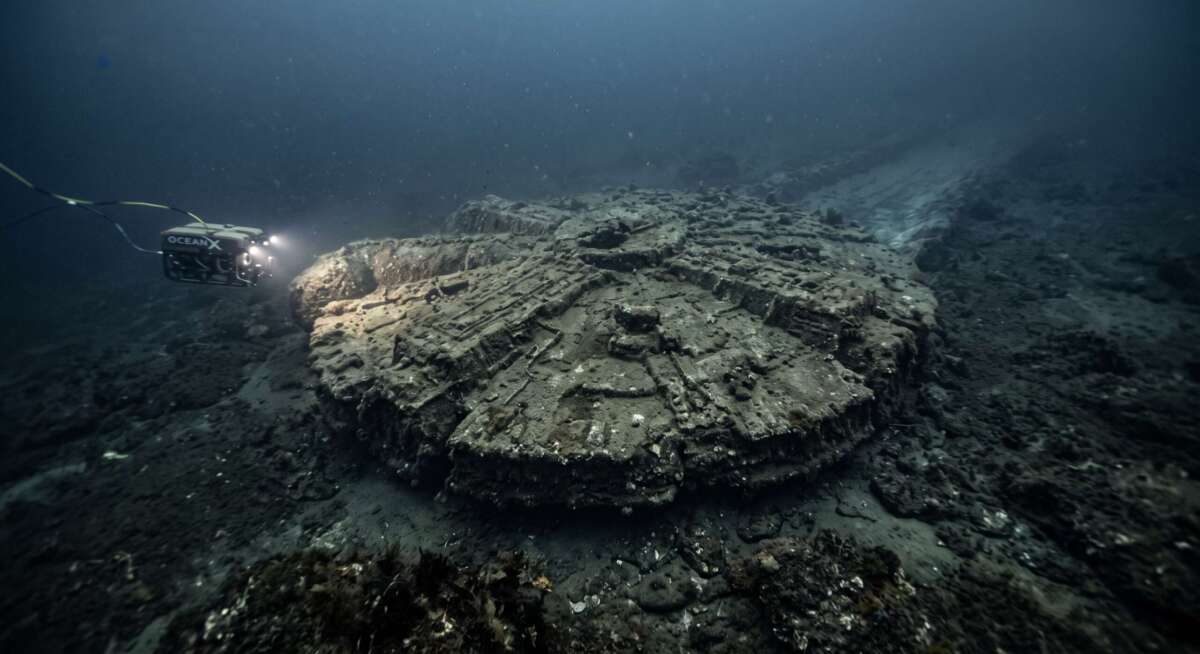
In June 2011, a Swedish ocean exploration and treasure-hunting team called OceanX was scanning the floor of the northern Baltic Sea in the Gulf of Bothnia. Led by Peter Lindberg and Dennis Åsberg, the crew was hunting for historical shipwrecks, specifically targeting a sunken vessel carrying cases of rare champagne when their side-scan sonar picked up a strikingly unusual shape resting at a depth of around 85 to 90 metres (approx. 300 feet).
The sonar image revealed a massive, circular structure roughly 60 metres (200 feet) in diameter. Due to its rounded shape, rigid right-angle patterns, and what appeared to be stair-like steps or ledge features, media outlets immediately pointed out its uncanny resemblance to the Millennium Falcon from Star Wars. To add to the mystery, sonar scans showed a flattened 300-meter scoured track or trench on the seabed directly behind the object, sparking immediate theories that something had skidded or crash-landed across the ocean floor.
Wild Theories & The 2012 Expedition
With blurry sonar images captivating public imagination worldwide, tabloid headlines and online speculative communities quickly seized on a range of theories:
Crashed Extraterrestrial Spacecraft: The most popular speculation claimed the disc was a sunken alien vessel or Unidentified Anomalous Phenomenon (UAP).
World War II Military Relic: Some hypothesized it could be a secret Nazi anti-submarine device, a submarine trap, or a sunken gun turret.
Prehistoric Monument: Others proposed it was a megalithic structure built during the last Ice Age (~12,000 to 14,000 years ago) when sea levels were lower, and the Baltic region was dry land.
When OceanX returned to the site in 2012 for a follow-up expedition using remotely operated vehicles (ROVs) and divers, their reports only fueled the rumours. Divers claimed the formation sat on a pillar-like base and featured flat walls, right-angled corridors, and soot-covered stone arrangements surrounding small hole-like features.
The Mystery of the Glitching Electronics
A major driver of the Baltic Sea Anomaly lore was the OceanX crew’s claim that their electronic equipment malfunctioned directly above the structure:
The 200-Meter Dead Zone: Diver Stefan Hogerborn and team leaders reported that satellite phones, cameras, and diving gear repeatedly shut down or stopped functioning when the boat hovered within a 200-meter radius of the object.
Signal Restoration: According to the team, as soon as the vessel moved beyond that 200-meter boundary, the electronic devices powered back on and satellite connections were restored.
Sonar Drop-Outs: The crew noted severe horizontal drop-outs and signal degradation on their sonar feeds whenever they attempted to scan directly over the structure, leading fringe researchers to suggest the anomaly was emitting an electromagnetic pulse (EMP).
What Actually Happened to the equipment?
Scientists and equipment experts who looked into these claims offered much simpler explanations:
Sonar Signal “Contamination” & Calibration: Dr. Hanumant Singh of the Woods Hole Oceanographic Institution analysed the sonar feeds and noted that the imagery issues were not caused by an energy field, but by poorly wired, uncalibrated equipment. Electrical “cross-talk” between improperly shielded cables on the boat caused one signal channel to visually corrupt another, creating artificial line artifacts and drop-outs.
Satellite & Marine Conditions: High-latitude marine environments like the Gulf of Bothnia regularly experience intermittent satellite coverage. Combined with cheap, non-waterproof power supplies exposed to salt spray, electronic glitches are standard operational hurdles rather than anomalous disruptions.
No Electromagnetic Signature: Magnetic testing of recovered stone samples showed ordinary terrestrial signatures, ruling out any dense magnetic core capable of disrupting radio frequencies or satellite navigation signals. However, whilst real-world GPS jamming is currently documented in the Baltic region, experts clarify that these modern disruptions stem from regional military electronic warfare, entirely unrelated to this natural seabed feature.
What Scientists Say: Rocks and Moving Ice
Despite the sensational claims, geologists, oceanographers, and marine archaeologists overwhelmingly view the Baltic Sea Anomaly as a naturally occurring geological feature.
Stone samples collected near the structure were sent to Dr. Volker Brüchert, an associate professor of geology at Stockholm University, for geochemical analysis. The mineral composition of the samples consisted almost entirely of granite, gneiss, and sandstone, standard continental crust rocks abundant across the Baltic seafloor.
While one sample was basalt (hardened volcanic lava), a rock not usually found in that exact spot, geologists explained that massive glaciers picked up heavy rocks and carried them hundreds of miles across Europe during the Ice Age, dropping them when the ice melted. Other crusty metal-like rocks found nearby turned out to be ordinary iron and manganese deposits that naturally clump together underwater over long periods.
Geologists concluded the main structure is likely a natural pile of rock debris dropped by an ancient glacier, while the “skid mark” behind it was simply a channel scoured out by retreating ice sheets during the last Ice Age.
Optical Illusions and Internet Hype
Acoustic imaging experts have also challenged the validity of the visual evidence. Acoustic scientists emphasised that standard side-scan sonar frequently introduces visual artifacts. Vessel motion, electrical interference, and improperly calibrated hardware regularly distort organic rock formations into crisp, deceptively geometric patterns. Much of the popular imagery circulated on the internet was not raw sonar data at all, but artist renderings that exaggerated straight lines and metallic features.
Finally, critics pointed out that OceanX operates as a commercial salvage and treasure-hunting company rather than a research institution. Following the discovery, the team sought commercial sponsors and announced plans to charge wealthy tourists for submarine tours of the site, leading many in the scientific community to suggest that the ongoing mystery was driven as much by media exposure and commercial interest as it was by anomaly hunting.
The Baltic Sea Anomaly could be considered a classic case of pareidolia, the natural human habit of seeing familiar patterns, like a flying saucer, in completely random natural objects. Or, it could be something else entirely different, something that we yet don’t have the answers to. Quietly and patiently sitting on the bottom of a desolate ocean floor, waiting for its time to announce itself to the wider world.



Leave a Reply