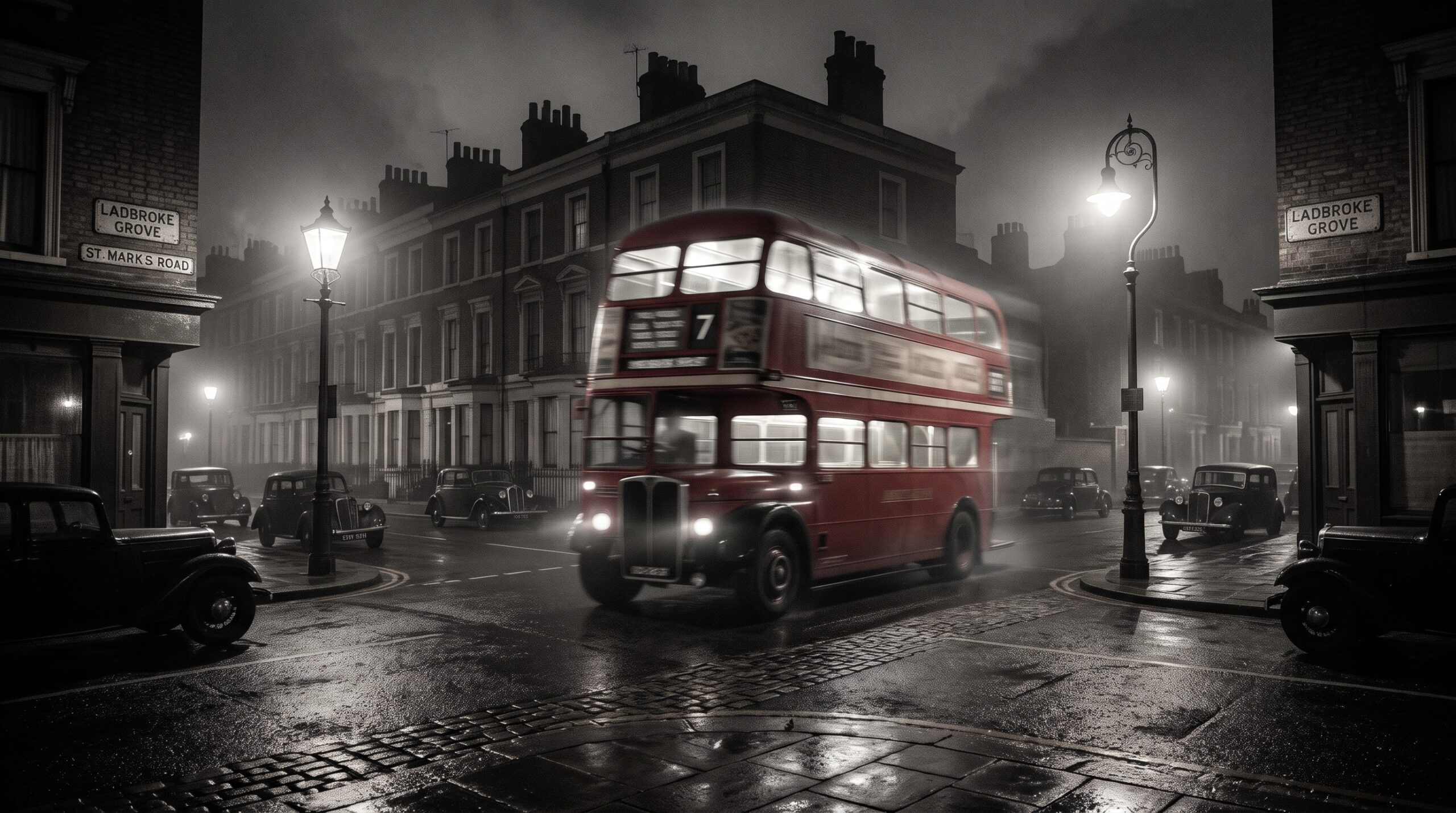
The ghostly apparition of a London double-decker
Late at night in the early 1930s, along a dimly lit stretch of North Kensington, drivers reported a terrifying sight: a bright red double-decker bus barrelling down the road at breakneck speed, its interior fully illuminated, heading straight into oncoming traffic before vanishing into the dark.
Known as the Phantom Bus of Ladbroke Grove, it remains one of London’s most enduring mid-century urban legends, a story that blends real-world motoring tragedy, sensationalist press coverage, and decades of evolving storytelling.
The Legend and the Origins of Route 7
According to popular London folklore, the ghost bus made its appearances near the junction of Ladbroke Grove and St. Mark’s Road, typically around 1:15 AM. Unsuspecting motorists or cyclists negotiating the turn would suddenly see a red double-decker charging toward them with all its lights blazing, yet witnesses claimed there were no passengers inside, no visible driver at the wheel, and no sound of a roaring engine. To avoid a head-on collision, terrified drivers swerved, often mounting the pavement or crashing into walls, only to look back and find the road behind them completely empty.
In later retellings, the phantom vehicle was frequently identified as a Route 7, a detail that carries a fascinating split between real-world transport history and local community invention.
Route 7 is one of London’s oldest continuous bus services, officially receiving its number on 1 November 1908. Originally running daily between Wormwood Scrubs in West London and Liverpool Street in the City, buses serving the western end of the corridor operated out of the nearby Middle Row Bus Garage or the Wormwood Scrubs terminus. Within the geography of the myth, witnesses claimed the spectral bus would emerge from St. Mark’s Road or Cambridge Gardens, cut across Ladbroke Grove, and vanish heading directly toward the local depot.
Ghostly accounts often describe the bus bearing the classic “General” logo of the London General Omnibus Company. However, by 1933–1934, when the legend first made headlines, London’s buses had already been absorbed into the newly formed London Passenger Transport Board (London Transport) and were being repainted accordingly.
None of the contemporary 1934 newspaper articles or inquest records ever mentioned a route number. The “Route 7” designation wasn’t attached to the story until 1982, when author J.A. Brooks included it in his book Ghosts of London, likely selecting a real, recognizable route that physically ran past that exact North Kensington junction to ground his retelling in local reality.
The 1934 Crash and the Inquest That Sparked a Myth
While tales of ghostly transport often float entirely on campfire hearsay, the Phantom Bus has a concrete historical anchor: a fatal accident that occurred in the early hours of June 1934.
At the junction of Cambridge Gardens and St. Mark’s Road, a 25-year-old motorist named Ian Beaton crashed into a Rolls-Royce. Beaton’s car overturned and tragically burst into flames, killing him. During the subsequent coroner’s inquest, a local resident named Frederick Robinson took the witness stand to discuss the dangerous layout of the intersection. When explicitly asked by counsel if this was the corner notorious for accidents and “a spot where the ghost or phantom bus is supposed to be seen”, Robinson simply confirmed that he was aware of the local rumour.
The coroner ultimately recorded a verdict of accidental death, making no official finding of supernatural intervention. However, fleet-footed newspaper reporters attending the inquest picked up on the brief courtroom exchange. Within days, local whispers were elevated into sensational headlines connecting the tragic crash to a spectral bus.
Hearsay, Rumours, and Local Reporters
Following the 1934 headlines, journalists from publications like The Daily Telegraph descended upon North Kensington to interview locals. Rather than direct eyewitnesses, what they uncovered was a web of third-hand stories and neighbourhood gossip:
The Vanishing Bus Stop: A motorist named T.H. Henn recounted a story about a woman who claimed to have seen a double-decker bus pull up to a stop. As she walked over to board, the bus allegedly dissolved into thin air.
The Petrol Station Myth: Dr. A.K. Gibson shared a story about a phantom bus pulling into a local garage to refuel, only to vanish the moment the mechanic walked out into the garage forecourt.
The Mechanic’s Reality Check: William Hampton, a local mechanic working on St. Mark’s Road, offered a more grounded perspective. He told reporters that the entire phenomenon seemed to stem from a single, exaggerated local story that had been circulating around 1931–1932.
Paranormal researchers and historians investigating police archives have found no signed first-hand statements or official police entries from drivers claiming they were forced off the road by a ghost bus. Much like the “Route 7” number added in 1982, other famous specifics, such as the exact 1:15 AM timestamp and claims of “hundreds of witnesses,” were apparently popularised decades later by writer Harry Ludlam in 1969.
A Practical Explanation: Bad Geometry and Poor Lighting
However, behind the supernatural tale lies a very real civil engineering problem. In the 1930s, the junction connecting St. Mark’s Road, Cambridge Gardens, and Ladbroke Grove was a notoriously dangerous blind spot.
The intersection suffered from early 20th-century street lamps that left wide, dark gaps across the road, a difficult road camber that made high-speed cornering treacherous, and buildings and high walls that obscured sightlines until vehicles were already inside the junction.
Driven by the spike in nighttime accidents and the publicity surrounding the 1934 inquest, London transport authorities finally intervened. They straightened the junction, altered the road camber, and dramatically improved the street lighting. Once the road layout was redesigned and modern lighting was installed, the late-night crashes stopped, and with them, any further sightings of the Phantom Bus vanished for good.
The legend of the Phantom Bus of Ladbroke Grove occupies a fascinating space in London ghost story-telling history, sitting precisely at the crossroads where genuine road hazards, high-speed night traffic, and early 20th-century sensationalism collided.
While civil engineering ultimately fixed the dangerous junction at St. Mark’s Road and brought an end to the crashes, the story itself refused to be so easily straightened out, growing richer over the decades with borrowed route numbers, specific timestamps, and spectral detours toward Middle Row Garage.
Yet, as with many of London’s oldest urban myths, one small mystery lingers: whether the legend was purely born out of a notoriously dark, badly angled corner and a few imaginative reporters, or if, in those quiet early hours of the 1930s, something truly unexplainable was briefly glimpsed in the glare of the headlights, and is still silently driving through the dark streets of London.
Leave a Reply