Folklore, Architecture, and Ghostly Encounters
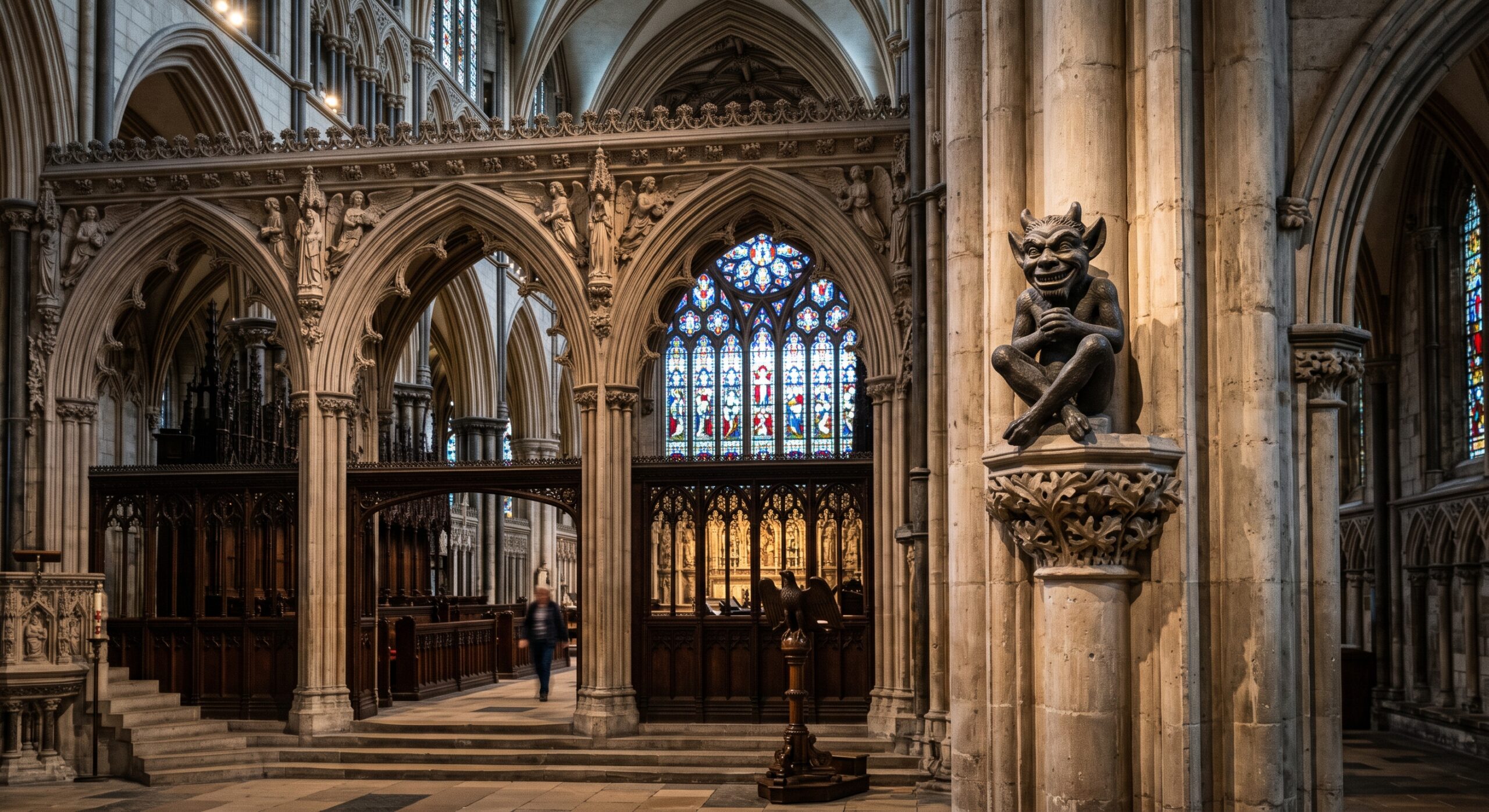
Perched high on a stone pillar inside the Angel Choir of Lincoln Cathedral sits a tiny, mischievous creature frozen in time. With cloven hooves, bovine ears, and a wide, gap-toothed grin, the Lincoln Imp is one of Britain’s most iconic medieval stoneworks.
Over the centuries, this humble limestone grotesque has transcended its architectural roots to become a cornerstone of Lincolnshire folklore, a vibrant, green-faced mascot, and the anchor for centuries of eerie hauntings and anomalous reports surrounding the cathedral precinct.
The Legend and Origins: From Medieval Stone to Green Goblin
The story of the Lincoln Imp begins in medieval times, though its most famous form was popularised through Victorian folklore. According to local legend, Satan dispatched a pair of troublesome little imps to Earth to cause havoc across the English countryside. Flying into Lincolnshire, they rode a howling gale straight through the great oak doors of Lincoln Cathedral.
Once inside the sacred sanctuary, the pair went wild. They flipped over pews, tripped up the bishop, blew out the altar candles, and badgered the terrified choirboys. Appalled by the desecration, an angel emerged from an illuminated book resting on the lectern and commanded the imps to cease their mischief.
While one timid imp scurried under a pew to hide, the bolder imp flew straight up to the top of a stone pillar. From his high perch, he taunted the angel and hurled heavy stone fragments at her. Without hesitation, the angel turned the insolent creature into solid stone, trapping him mid-cheer with his legs crossed. The second imp fled through the heavy cathedral doors into the night, leaving behind a bitter, lingering gale. Local history maintains that this escaping imp still circles the cathedral exterior today, creating the perpetual wind that whips around the stone walls while he endlessly awaits his petrified companion.
Architecturally, the actual carving was crafted around 1280 AD during the construction of the Angel Choir, built to house the grand shrine of St Hugh of Lincoln. Measuring just 30 cm (12 inches) tall, the carving is technically a grotesque, a decorative architectural carving designed to ward off evil or offer light-hearted satire, rather than a gargoyle, which functions specifically as a waterspout. Stonemasons of the era frequently carved cheeky, monstrous, or satirical figures into high, unseen corners of cathedrals as subtle jokes or moral allegories demonstrating evil subdued in the presence of the divine.
Although the medieval stonemasons carved the Imp out of pale Lincoln limestone, the 19th and 20th centuries transformed his visual identity. Late Victorian souvenir makers, regional artists, and local writers began leaning into British green-man and goblin aesthetics, recasting the Imp as a bright green, pointed-eared creature. Today, the green-faced Imp is the universal symbol of the city, serving as the official emblem and mascot for Lincoln City Football Club (nicknamed “The Imps”) and inspiring public art trails and souvenir knick-knacks throughout Lincolnshire.
Paranormal Encounters in the Shadow of the Cathedral
While no documented eyewitnesses have ever claimed to see a living, flesh-and-blood imp hopping across the City, Lincoln Cathedral and its immediate perimeter carry a dense history of ghostly sightings, disembodied sounds, and inexplicable occurrences.
Inside the cathedral walls, staff and visitors have long reported encounters with phantom clergy. The most famous of these is the “Clanking Cleric”, a figure clad in dark medieval vestments who glides silently up and down the interior stone stairways. Witnesses consistently report the faint, rhythmically cold sound of heavy iron chains clanking against stone before the figure appears. Legend holds that the cleric wears a heavy chain wrapped around his neck as an eternal act of penance for a forgotten transgression, vanishing into the deep shadows near the choir stalls.
In the mid-20th century, a darker chapter was added to the cathedral’s ghostly aura, following the tragic fatal fall of a woman named Constance from the upper levels in the 1960s. Visitors standing in the nave or beneath the central tower have occasionally reported an unsettling phenomenon: the shadowy outline of a figure plunging from the upper triforium, only to dissolve into thin air before striking the stone floor below.
Modern technology has also documented the cathedral’s eerie reputation. In June 2016, paranormal investigator Mark Vernon captured video footage in broad daylight during ongoing restoration work. His cameras caught a semi-transparent, dark silhouette passing across an archway, accompanied by electronic voice phenomena (EVP) audio where a voice identifying itself as “Father Daniel” declared that the recent building works had disturbed long-dormant spirits.
Outside the cathedral doors, the ancient precinct, built over layers of Roman, Saxon, and Medieval history, is equally active. Descending from the Cathedral Quarter, the narrow, cobbled Greestone Stairs are famous for the phantom of a cathedral cleric in a long dark coat and wide hat who lingers near a crooked iron lamppost. On the same steps, witnesses have reported a weeping nun carrying a small infant, hurrying down the path before kneeling at a flowerbed where both figures fade from sight. Even the cathedral’s steps carry bizarre sightings, including long-standing tales of a heavy, unseen object bouncing down the stones behind unsuspecting walkers, a phenomenon local tradition links to the 13th-century theft of the reliquary chest holding the head of St Hugh.
A Detailed Chronology of Events
1280 AD. The Carving of the Imp
Medieval stonemasons carve a small, 30 cm grotesque into a pillar corbel on the north side of the Angel Choir during the construction of the shrine of St Hugh of Lincoln.
1285 AD. The Theft of St Hugh’s Reliquary
Thieves break into the cathedral and steal the gold-and-jewelled reliquary chest containing the head of St Hugh. Folklore later links this event to the bizarre phenomenon of invisible objects bouncing down the cathedral steps.
Victorian Era (19th Century). The Green Imp Identity Takes Root
Victorian historians record and popularize the legend of Satan’s two imps. Local artisans begin mass-producing green-faced iron and brass door knockers, statuettes, and jewellery, permanently establishing the Imp’s green colour scheme.
1884. Lincoln City Football Club Adopts “The Imps”
Lincoln City F.C. is established, adopting the red-and-green Imp as their official emblem and mascot, cementing the creature’s status as the regional icon.
1960s. The Roof Tragedy and Plunging Phantom
Following the fatal fall of a woman named Constance from the cathedral’s upper works, reports begin emerging of a shadowy figure seen falling from the triforium and vanishing before impact.
Late 20th Century. Persistent Cleric Encounters
Numerous cathedral wardens, visitors, and local residents document repeated sightings of the “Clanking Cleric” inside the nave and the guardian cleric standing under the lamppost on the Greestone Stairs.
June 2016. The “Father Daniel” Paranormal Footage
Investigator Mark Vernon records daylight video of a shadowy entity moving near the restoration area inside the cathedral and captures an EVP audio recording attributed to a spirit called “Father Daniel.”
July to September 2021. The Lincoln Imp Trail
A major public art exhibition places dozens of large, artist-painted Imp statues throughout the city centre and around the cathedral perimeter, celebrating the centuries-old intersection of local history, art, and urban legend.
The Unbroken Circle: An Open Conclusion
From a single block of medieval limestone carved in the 13th century to a vibrant green icon woven into modern Lincolnshire identity, the Lincoln Imp occupies a unique space where architectural history, folk myth, and regional ghost stories collapse into one another. Whether viewed strictly through the lens of medieval stonemasonry, cultural reasonings, or persistent paranormal activity, the cathedral precinct remains a magnet for the unexplained.
As twilight falls over Steep Hill and the sharp Lincolnshire winds cut through the ancient stonework of the Cathedral Quarter, one can’t help but wonder if the stories ever truly ended. The petrified imp remains frozen high in the Angel Choir under the glow of a permanent spotlight, forever locked in stone, but outside, the icy gale continues to howl around the limestone spires, as relentless today as it was centuries ago. Is it merely a quirk of local meteorology, or is the second imp still circling the cathedral doors in the dark, waiting for his companion to finally step down from his pillar?
Leave a Reply