Inside the 1977 West Wales UFO Wave
In 1977, the rural county of Dyfed in West Wales became the focus of one of the densest collections of UFO reports ever recorded in the United Kingdom. Dubbed the “Broad Haven Triangle” by local journalists, the region generated over 75 logged incidents within twelve months. The sightings ranged from low-flying craft and vehicle stalls to physical ground traces and repeated encounters with tall, silver-suited figures.
Declassified Ministry of Defence files, military memos, and decades of follow-up investigation reveal an intricate crossover between local witnesses, Cold War defence infrastructure, government inquiry, and enduring media coverage.
The Broad Haven Primary School Sighting
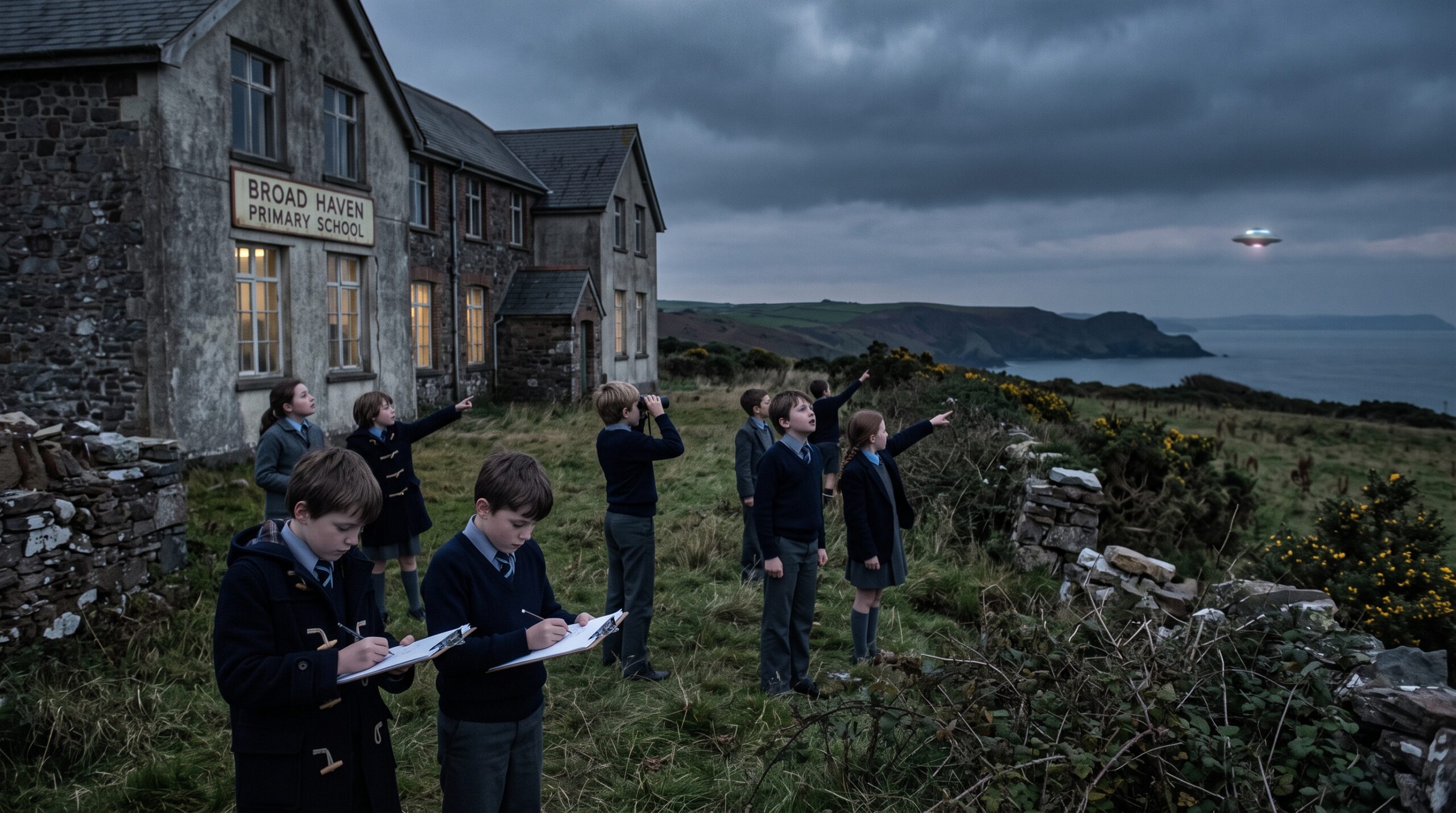
The wave gained national attention on Friday, February 4, 1977, at Broad Haven Primary School in Pembrokeshire. During their afternoon break, 14 pupils reported seeing a silver, dome-topped disc hover and land in a marshy field adjacent to the school playground. Several pupils stated that a tall figure in a seamless, metallic suit emerged from or stood near the craft before it departed into the tree line.
Upon returning to the classroom, the children reported the sighting to their teachers, who initially dismissed the account as an exaggerated game. However, due to the pupils’ persistent distress, headmaster Ralph Llewellyn intervened. To test the validity of their claims, Llewellyn isolated the 14 children in separate rooms and instructed them to draw what they had seen without conferring.
The resulting sketches demonstrated a high degree of structural consistency. Almost all independent drawings depicted a crescent or dome-topped craft with a central light or spire, alongside a tall figure in a silver suit. Llewellyn forwarded the drawings and accounts to local police and military authorities at nearby RAF Brawdy, marking the formal beginning of official record-keeping on the incident.
Escalation Across the Dyfed Coast
The schoolyard incident was part of a broader sequence of reported encounters across the Pembrokeshire coastline throughout the spring and summer of 1977.
Ripperston Farm
Located near Broad Haven, Ripperston Farm became a central location for reported unexplained activity. Pauline Coombs and her family logged months of continuous incidents. Their reports included:
Recurring views of large, glowing orange spheres and silver discs hovering low over coastal cliffs. Nighttime appearances of a 7-foot-tall, featureless figure clad in reflective metallic fabric looking through farmhouse windows. Unexplained vehicle failures, including car engines and headlights cutting out on roads surrounding the property. An incident where an entire herd of cattle was reportedly found inside a locked, closed field miles away from their pasture without any broken fences or gates.
The Haven Fort Hotel
In April 1977, Rosa Granville, proprietor of the Haven Fort Hotel in Little Haven, reported waking up in the early morning hours to a blinding white light outside her window. Looking down toward the cliff edge, Granville claimed to see a large, inverted saucer-shaped craft resting on the lawn, emitting intense heat and a pulsating glow. She reported seeing two tall, silver-suited figures walk around the perimeter of the object before it lifted off vertically and disappeared over the sea.
The following morning, Granville and hotel guests inspected the site, finding a distinct, scorched ring embedded in the turf. The thermal mark remained visible in the grass for several months.
Stack Rock and St. Brides Bay
Along the coast of St. Brides Bay, multiple independent witnesses reported observing bright, silent objects descending into the water near Stack Rock, a small, uninhabited rocky islet off the Pembrokeshire coast. Local reports began circulating that a light or sliding “doorway” had appeared on the rock face itself, through which silver-clad entities were observed moving. This led local researchers to speculate about potential underwater or subterranean anomalies in the bay.
The Declassified MoD Files
Whilst the Ministry of Defence publicly maintained that the Dyfed events possessed “no defence significance” and posed no threat to national security, declassified files released by The National Archives demonstrate that internal inquiries were indeed carried out.
Secret Inquiries and Military Directives
Following Rosa Granville’s encounter at the Haven Fort Hotel, her local Member of Parliament, Nicholas Edwards, forwarded her written statement directly to the Secretary of State for Defence. In response, memos from Sec(AS)2 (the Ministry of Defence’s dedicated UFO desk) instructed the RAF Provost & Security Service (the internal police branch of the Royal Air Force) to conduct a discreet investigation. A Flight Lieutenant was dispatched to Little Haven to inspect the scorched grass mark and interview Granville privately.
Intelligence officers also checked internal radar logs from nearby installations, including RAF Brawdy and RAF Valley. While no unexplained radar tracks were officially logged on the dates corresponding to major sightings, military files acknowledged heavy air traffic due to ongoing NATO training exercises along the Irish Sea corridor.
Working Hypotheses in Government Records
Within internal memos, RAF security personnel and Ministry of Defence analysts compiled several potential explanations for the cluster of reports:
Illumination Flares: RAF Brawdy and the Castlemartin firing range regularly conducted night-firing exercises using high-intensity artillery and parachute flares. Investigators noted that these flares, drifting in coastal winds, could account for reports of slow-descending orange orbs over the sea.
The Refinery Suit Hoax: An internal memo from an RAF police investigator suggested that at least one sighting of a giant figure in a silver suit was the work of a local prankster using a heavy, fireproof suit borrowed or stolen from a nearby oil refinery in Milford Haven.
Agricultural and Industrial Floodlights: Analysts noted that farmers using modern halogen floodlights on heavy machinery late at night, combined with low-lying coastal fog, could create unusual visual reflections and shapes to onlookers from a distance.
Despite these working theories, official files did not formally close several primary cases, including the matching schoolyard drawings or the physical ground depressions at the hotel.
Media Coverage and Documentary Inquiries
The Broad Haven wave was widely covered from its inception and has continued to attract investigative documentary producers across radio, television, and streaming media.
Contemporary Coverage (1977)
When news of the primary school sighting broke, BBC Wales and national news channels immediately dispatched crews to Pembrokeshire. Archival broadcasts captured early interviews with headmaster Ralph Llewellyn and the primary school children displaying their sketches. As additional reports emerged from local residents like Rosa Granville, national UK newspapers and television bulletins closely tracked the military’s public responses.
BBC Investigations
The BBC has repeatedly returned to the Dyfed events over subsequent decades. Most notably and most recently in 2024, the BBC series Paranormal: The Village That Saw Aliens, hosted by Sian Eleri, dedicated a full multi-part investigation to the 1977 wave. The production team revisited Pembrokeshire to re-examine declassified Ministry of Defence archives, analyse local flight routes from RAF Brawdy, and conduct new interviews with surviving eyewitnesses. Additionally, BBC Radio 4 and BBC Radio Wales have produced numerous retrospective documentaries examining the cultural footprint and military correspondence associated with the sightings.
Modern Streaming Features
The Broad Haven wave has also achieved international exposure through major streaming projects including Netflix’s Encounters in 2023. Executively produced by Steven Spielberg’s Amblin Television, this four-part documentary series featured the Broad Haven Triangle in a dedicated episode. It brought together primary witnesses, now adults, who reflected on how the 1977 event impacted their lives, alongside analysis from UFO researchers, military veterans, and investigative journalists.
Subsequent Reports and Long-Term Legacy
The activity in West Wales did not cease with the end of 1977. Sightings along the Pembrokeshire coastline continued into 1978 and 1979, with visiting researchers logging further reports of lights entering St. Brides Bay.
Freedom of Information requests submitted to Dyfed-Powys Police in later years revealed a steady stream of anomalous aerial reports logged by law enforcement through the 1980s, 1990s, and 2000s:
2004 (Aberdyfi Estuary): A motorist reported a massive craft hovering low over the road. As the object passed, the car’s electrical system, radio, and engine died completely, echoing the Coombs family accounts from 1977.
2005 (Llanyre): Witnesses logged a yellow, oblong craft traveling horizontally just 10 to 15 feet above ground level.
2007 (Meifod): Reports were filed regarding a large, triangular craft with pulsing lights on each corner moving silently overhead.
2009 (Cardigan): Multiple callers reported formations of bright orange lights moving across the coastline in structured patterns.
An Unresolved Chapter in the Welsh Countryside
Decades after the 1977 events, the Broad Haven wave stands apart from typical UFO mysteries due to its sheer density, diversity of witnesses, and physical ground evidence. Rather than relying on isolated late-night sightings by single observers, the Dyfed accounts involved entire school classes, hotel guests, local farmers, and police officers across broad daylight and early evening hours. The intervention of local Members of Parliament, secret RAF police dispatches, and declassified Ministry of Defence memos further confirm that the British government took the concentration of events seriously behind closed doors, even while publicly minimising its national defence significance.
Whether explained through a convergence of military exercises, industrial hoaxes, environmental optical conditions, or genuine anomalous activity, the Broad Haven wave fundamentally altered the cultural identity of West Wales. Before 1977, strange occurrences along the rural coastline were framed through the centuries-old lens of Welsh folklore, spirits, and mysterious lights. After 1977, that narrative permanently shifted toward advanced technology, government archives, and unanswered questions in the sky.
Ultimately, the Broad Haven Triangle resists easy categorisation. The original schoolchildren have overwhelmingly stood by their testimonies for nearly half a century, dismissing claims that they collaborated on an elaborate prank. The scorched turf at Little Haven has long since grown over, and the military bases that once dotted the Pembrokeshire coastline have changed operations or closed, yet the central mystery remains largely untouched.
Was the 1977 wave a temporary flash of collective socio-cultural hysteria amplified by Cold War military testing, or did something genuinely inexplicable touch down on the edge of West Wales? As declassified archives remain incomplete and eyewitnesses maintain their accounts, the true nature of what transpired in the Broad Haven Triangle remains open to history and opinion.
Leave a Reply